Introduction
In the realm of machine learning and natural language processing, embeddings have emerged as a powerful tool for representing data in a meaningful and efficient way. With the advent of Embeddings As a Service (EaaS), the accessibility and utility of embeddings have reached new heights. This article explores the concept of embeddings, their significance, and how EaaS is revolutionizing the landscape of AI-driven applications.
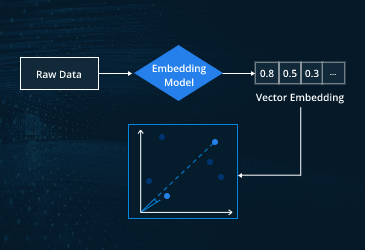
Understanding Embeddings: The Backbone of AI
At its core, an embedding is a numerical representation of objects or concepts in a high-dimensional space. In the context of natural language processing (NLP), word embeddings map words from a vocabulary to continuous vectors of real numbers. This representation preserves semantic relationships between words, enabling algorithms to understand language in a more nuanced manner.
The Power of Embeddings in Machine Learning
Embeddings play a pivotal role in various machine learning tasks, including text classification, sentiment analysis, machine translation, and recommendation systems. By capturing the underlying relationships between entities, embeddings enhance the performance and accuracy of models, enabling them to make more informed predictions and decisions.
Challenges in Embedding Generation
While embeddings offer tremendous benefits, generating high-quality embeddings can be a challenging task. Traditionally, creating embeddings requires significant computational resources and expertise in machine learning techniques. Moreover, optimizing embeddings for specific tasks and domains necessitates fine-tuning and experimentation, adding another layer of complexity.
Enter Embeddings As a Service (EaaS)
Embeddings As a Service (EaaS) addresses these challenges by providing pre-trained embeddings through a convenient and accessible API. EaaS platforms leverage large-scale datasets and sophisticated algorithms to generate embeddings that capture rich semantic information. By offering embeddings as a service, these platforms democratize access to state-of-the-art embedding models, empowering developers to integrate them seamlessly into their applications.
Benefits of EaaS
- Accessibility: EaaS platforms eliminate the need for organizations to invest in expensive hardware and expertise for embedding generation. Developers can access high-quality embeddings with a simple API call, accelerating the development cycle and reducing time-to-market.
- Scalability: EaaS providers scale infrastructure dynamically to accommodate varying workloads, ensuring consistent performance and reliability. Whether processing a small dataset or millions of documents, developers can rely on EaaS to deliver fast and efficient embedding generation.
- Customization: While pre-trained embeddings suffice for many applications, EaaS platforms also offer customization options for specific use cases. Developers can fine-tune embeddings on domain-specific data or adjust parameters to optimize performance for their particular task.
- Interoperability: EaaS seamlessly integrates with existing machine learning frameworks and libraries, such as TensorFlow and PyTorch. This interoperability enables developers to leverage embeddings within their preferred development environment without any friction.
Use Cases of Embeddings As a Service
- Natural Language Understanding: EaaS powers a wide range of NLP applications, including sentiment analysis, named entity recognition, and document clustering. By providing contextually rich embeddings, EaaS enhances the accuracy and robustness of these applications.
- Content Recommendation: EaaS enables content recommendation systems to analyze user preferences and deliver personalized recommendations. By embedding user behavior and content attributes in a shared space, EaaS facilitates accurate matching and recommendation generation.
- Anomaly Detection: In cybersecurity and fraud detection, EaaS helps identify anomalous patterns in data by capturing the underlying semantics. By embedding network traffic logs, transaction records, or user behavior, EaaS enables algorithms to detect suspicious activity with high precision.
Conclusion: Empowering AI Innovation with EaaS
Embeddings As a Service (EaaS) represents a paradigm shift in the way embeddings are generated and utilized in machine learning applications. By democratizing access to state-of-the-art embedding models, EaaS platforms empower developers to build more sophisticated and intelligent AI-driven solutions. As the demand for AI capabilities continues to grow across industries, EaaS stands poised to play a pivotal role in driving innovation and advancing the frontier of artificial intelligence.
 Tech blog
Leave a comment