Artificial Intelligence (AI) is transforming numerous industries, and banking and finance are no exceptions. The integration of AI in banking and finance has brought about significant changes, enhancing efficiency, security, and customer experience. This article explores the various applications of AI in this sector and its potential future impact.
Enhancing Customer Experience
Personalized Banking
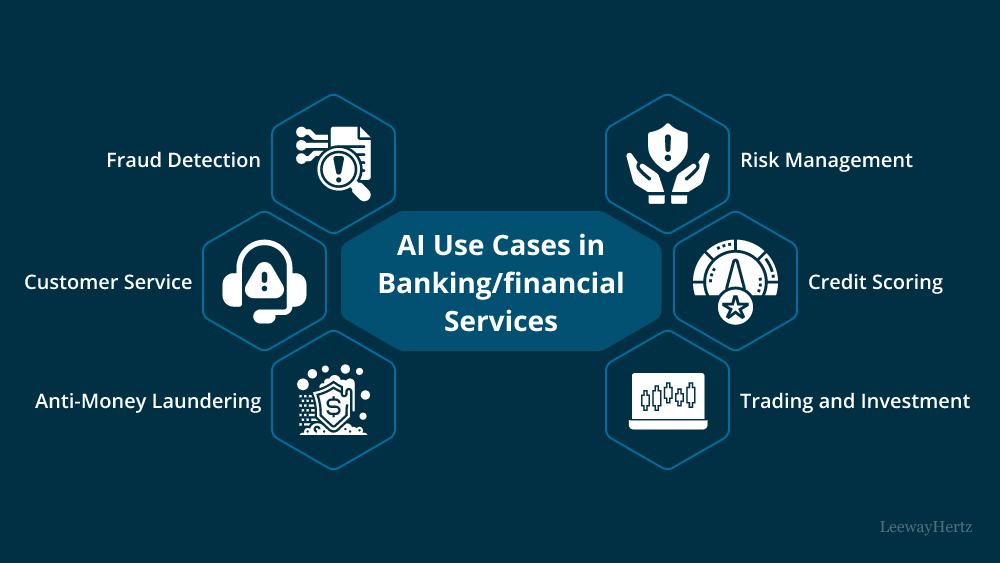
AI in banking and finance has revolutionized customer service by enabling personalized banking experiences. Banks and financial institutions leverage AI algorithms to analyze customer data, including transaction history and spending patterns, to offer personalized advice and product recommendations. This not only improves customer satisfaction but also fosters loyalty. Chatbots and virtual assistants, powered by AI, provide 24/7 customer support, answering queries, and assisting with transactions, which enhances accessibility and convenience for customers.
Fraud Detection and Prevention
AI plays a crucial role in enhancing the security of financial transactions. Traditional methods of fraud detection often involve manual reviews and can be time-consuming. AI, on the other hand, can analyze vast amounts of data in real-time, identifying unusual patterns and flagging potential fraudulent activities. Machine learning models can be trained to recognize even the slightest anomalies, thus providing robust protection against fraud. This capability significantly reduces the risk of fraud, safeguarding both financial institutions and their customers.
Operational Efficiency
Automation of Routine Tasks
One of the significant benefits of AI in banking and finance is the automation of routine tasks. Processes such as data entry, verification, and compliance checks, which are typically time-consuming and prone to human error, can be efficiently handled by AI systems. This not only speeds up operations but also reduces costs associated with manual labor. Robotic Process Automation (RPA), a form of AI, is widely used to streamline back-office operations, allowing employees to focus on more strategic tasks.
Risk Management
Risk management is a critical aspect of banking and finance, and AI is playing an increasingly important role in this area. AI systems can analyze historical data and current market trends to predict potential risks and provide early warnings. This predictive capability enables financial institutions to make informed decisions and take proactive measures to mitigate risks. AI-driven risk assessment models are also used to evaluate creditworthiness, enhancing the accuracy of loan approvals and reducing the likelihood of defaults.
Investment and Trading
Algorithmic Trading
Algorithmic trading, also known as algo-trading, is a significant application of AI in banking and finance. AI algorithms can execute trades at high speeds and with precision, based on pre-defined criteria and market conditions. This reduces human error and emotional bias, leading to more efficient and profitable trading strategies. High-frequency trading (HFT), a subset of algorithmic trading, leverages AI to capitalize on minute price discrepancies in the market, further optimizing trading outcomes.
Investment Advisory
AI is transforming investment advisory services through robo-advisors. These AI-powered platforms provide automated, algorithm-driven financial planning services with little to no human supervision. Robo-advisors use AI to create and manage a diversified portfolio tailored to an individual’s financial goals and risk tolerance. They continuously monitor market conditions and rebalance portfolios as needed, offering a cost-effective and efficient alternative to traditional financial advisors.
The Future of AI in Banking and Finance
Ethical and Regulatory Considerations
As AI continues to advance, ethical and regulatory considerations become increasingly important. Financial institutions must ensure that their AI systems are transparent and fair, avoiding biases that could lead to discriminatory practices. Regulatory bodies are also developing frameworks to govern the use of AI in banking and finance, aiming to protect consumers and maintain market integrity. Adhering to these regulations is crucial for building trust and ensuring the sustainable growth of AI technologies in the sector.
Innovation and Adaptation
The future of AI in banking and finance promises continued innovation and adaptation. Financial institutions are likely to invest heavily in AI research and development, exploring new ways to leverage AI for competitive advantage. Areas such as quantum computing and advanced machine learning techniques hold the potential to revolutionize financial modeling and forecasting. As AI technology evolves, its applications in banking and finance will expand, driving further efficiencies and transforming the way financial services are delivered.
Conclusion
AI in banking and finance is no longer a futuristic concept; it is a present reality reshaping the industry. From enhancing customer experience and operational efficiency to revolutionizing investment and trading, AI is driving significant changes. As financial institutions navigate the challenges and opportunities presented by AI, they are poised to offer more secure, efficient, and personalized services. The journey of AI in banking and finance is just beginning, and its potential to revolutionize the industry is immense.


Leave a Reply