Introduction
In the age of big data, the ability to identify anomalies—unexpected patterns or outliers in datasets—has become critical for organizations across various sectors. AI in anomaly detection leverages advanced algorithms and machine learning techniques to enhance the accuracy and efficiency of identifying these irregularities. This article explores how AI is revolutionizing the anomaly detection landscape, its benefits, and its applications in diverse fields.
Understanding Anomaly Detection
Anomaly detection is the process of identifying patterns in data that do not conform to expected behavior. These anomalies can signify critical incidents, such as fraud, network intrusions, or equipment failures. Traditionally, anomaly detection relied heavily on statistical methods, but the complexity and volume of data in today’s world necessitate more sophisticated approaches.
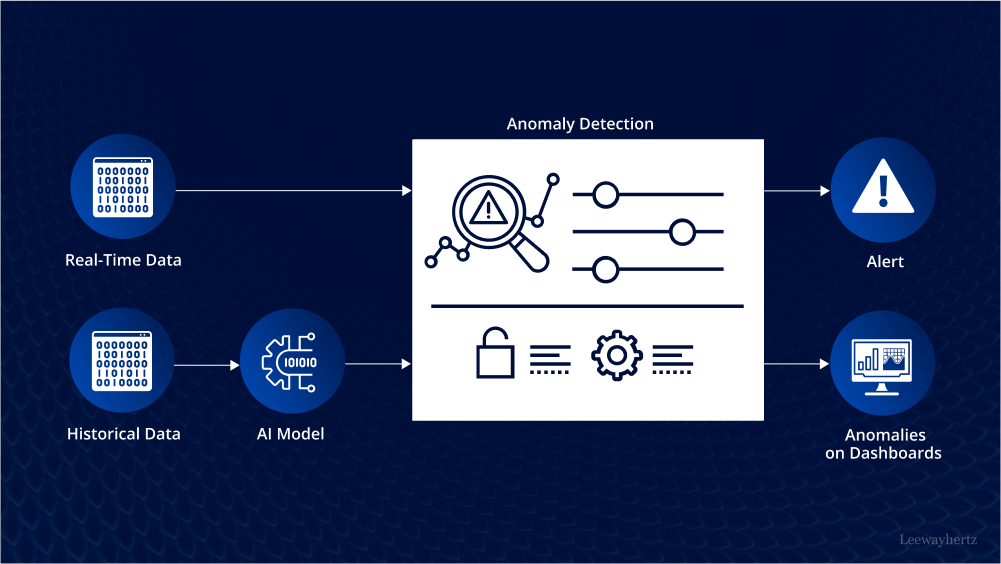
AI in anomaly detection employs machine learning and deep learning techniques to automate and improve the detection process. By training algorithms on historical data, these AI systems learn to recognize normal patterns, enabling them to swiftly identify deviations in real-time.
The Role of AI in Anomaly Detection
1. Enhanced Accuracy
One of the most significant advantages of using AI in anomaly detection is improved accuracy. Traditional methods may struggle with high-dimensional data or complex datasets, leading to false positives or negatives. AI algorithms, particularly those based on machine learning, can adapt to various data types and distributions, significantly reducing the error rate.
For instance, supervised learning models can be trained using labeled data to precisely distinguish between normal and anomalous patterns. Moreover, unsupervised learning models, which do not require labeled data, can uncover hidden patterns in datasets, making them invaluable in scenarios where labeled data is scarce.
2. Real-time Detection
In many applications, the ability to detect anomalies in real-time is crucial. For example, in cybersecurity, timely identification of a network intrusion can prevent significant data breaches. AI in anomaly detection systems can process large volumes of data in real time, ensuring that anomalies are detected as soon as they occur.
This capability is particularly important in industries such as finance, healthcare, and manufacturing, where timely intervention can mitigate risks and enhance decision-making. Real-time anomaly detection systems can alert organizations to irregular activities, enabling rapid response to potential threats.
3. Scalability
As organizations generate more data, the scalability of anomaly detection systems becomes essential. AI-driven solutions can easily scale with the increasing volume and variety of data. Unlike traditional methods, which may require extensive manual tuning and adjustments, AI in anomaly detection can automatically adapt to changing data patterns.
This scalability allows organizations to maintain effective anomaly detection as their data grows, ensuring ongoing protection against threats and enhancing overall operational efficiency.
Applications of AI in Anomaly Detection
1. Cybersecurity
In cybersecurity, AI in anomaly detection plays a pivotal role in identifying unusual patterns that may indicate cyber threats. By analyzing network traffic and user behavior, AI systems can detect anomalies that suggest potential breaches or malicious activities. This proactive approach not only enhances security measures but also minimizes the risk of data loss and financial damage.
2. Fraud Detection
Financial institutions leverage AI in anomaly detection to identify fraudulent activities. By analyzing transaction patterns, AI systems can quickly spot irregularities that may indicate fraud. This capability is vital for preventing financial losses and protecting customer assets. Additionally, AI can learn from past fraud cases, continually improving its detection algorithms over time.
3. Industrial Monitoring
In manufacturing and industrial sectors, AI in anomaly detection is used to monitor equipment health and performance. By analyzing sensor data, AI systems can detect signs of equipment failure or operational inefficiencies. Early detection of anomalies can help organizations implement maintenance measures before costly breakdowns occur, optimizing production processes and reducing downtime.
4. Healthcare
In healthcare, AI in anomaly detection assists in identifying unusual patient health patterns. For instance, monitoring vital signs in real time can alert medical professionals to potential health crises, such as heart attacks or respiratory failures. By analyzing historical health data, AI can also help predict potential health risks, enabling preventive care and improved patient outcomes.
Challenges in Implementing AI in Anomaly Detection
Despite the numerous advantages of AI in anomaly detection, several challenges remain. The quality and quantity of data are paramount; insufficient or poor-quality data can lead to ineffective models. Additionally, the complexity of some AI algorithms may require specialized knowledge to implement and maintain.
Moreover, ethical considerations regarding data privacy and security are crucial when deploying AI systems. Organizations must ensure that their anomaly detection practices comply with regulations and protect sensitive information.
Conclusion
AI in anomaly detection is transforming the way organizations identify and respond to unusual patterns in data. By enhancing accuracy, enabling real-time detection, and offering scalability, AI-driven solutions are essential in various sectors, including cybersecurity, finance, healthcare, and manufacturing. While challenges exist, the benefits of integrating AI into anomaly detection processes far outweigh the obstacles. As technology continues to evolve, the future of anomaly detection looks promising, paving the way for more secure and efficient operations across industries.
 Tech blog
Leave a comment