The manufacturing sector is undergoing a profound transformation, and generative AI is at the heart of this revolution. As businesses strive to stay competitive in a rapidly evolving market, adopting innovative technologies has become essential. Generative AI in manufacturing is reshaping how products are designed, produced, and maintained. This article explores how generative AI is transforming the industry, driving efficiencies, and fostering innovation.
What is Generative AI in Manufacturing?
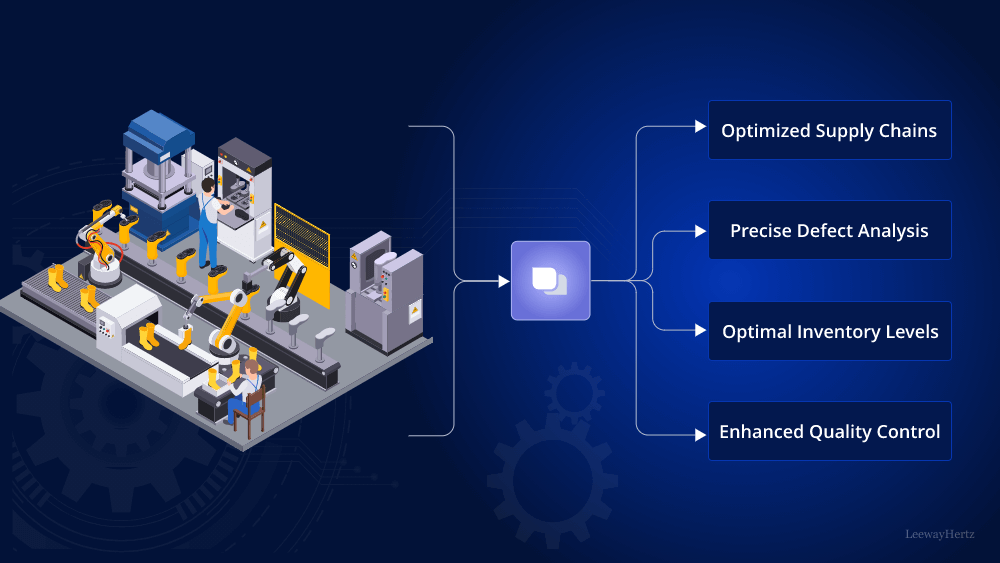
Generative AI refers to the application of artificial intelligence that can create new designs, optimize processes, and improve decision-making in the manufacturing environment. Unlike traditional AI, which follows pre-programmed rules, generative AI has the ability to analyze massive amounts of data and generate entirely new outputs. In the context of manufacturing, this means AI systems can generate novel product designs, optimize supply chains, predict maintenance needs, and much more.
By leveraging generative AI in manufacturing, businesses can produce more innovative products in less time while minimizing costs and reducing waste. This technology allows manufacturers to explore a wider range of designs, materials, and production methods, pushing the boundaries of what’s possible.
How Generative AI Enhances Product Design
One of the most significant benefits of using generative AI in manufacturing is its impact on product design. Traditional design methods often require human engineers to manually iterate on designs, which can be time-consuming and limited by human imagination. Generative AI, on the other hand, uses machine learning algorithms to explore thousands, if not millions, of design possibilities. It can generate completely new designs or optimize existing ones based on specific criteria like weight, strength, material use, and cost.
For example, generative AI can produce lighter yet stronger components by analyzing various design permutations that a human engineer might not consider. This not only enhances product performance but also reduces material consumption, which lowers production costs. Generative AI in manufacturing can, therefore, enable the creation of more efficient, sustainable, and innovative products with less manual effort.
Optimizing Manufacturing Processes with Generative AI
Generative AI in manufacturing is not just limited to product design; it also plays a crucial role in optimizing manufacturing processes. AI-powered systems can analyze production workflows and identify bottlenecks or inefficiencies that may not be immediately apparent to human operators. Once identified, these inefficiencies can be minimized or eliminated, leading to faster production times and lower operational costs.
For instance, generative AI can optimize how materials are used on a production line, reducing waste and ensuring that machines are operating at peak efficiency. By learning from historical data and real-time production information, generative AI systems can recommend process changes that result in more streamlined operations. This helps manufacturers save both time and resources while improving overall productivity.
Furthermore, generative AI in manufacturing can assist in adaptive production strategies. In traditional setups, changes in demand or material shortages could disrupt production schedules. However, with the aid of generative AI, manufacturers can adapt more fluidly to these changes by simulating multiple production scenarios and selecting the most efficient path forward. This flexibility is becoming increasingly valuable as supply chain disruptions become more frequent.
Predictive Maintenance and Generative AI
Maintaining machinery and equipment is critical in any manufacturing environment, as unexpected downtime can lead to significant losses. Generative AI in manufacturing is playing a vital role in predictive maintenance, allowing manufacturers to anticipate potential equipment failures before they happen. AI-powered models can analyze historical maintenance data, machine performance metrics, and environmental conditions to predict when a machine is likely to fail.
This proactive approach to maintenance reduces downtime and extends the lifespan of machinery. Instead of relying on routine checks or waiting for a breakdown, manufacturers can schedule maintenance activities only when needed, thereby minimizing disruptions to production. Predictive maintenance using generative AI in manufacturing is a game-changer, as it enhances reliability, improves safety, and reduces costs.
Sustainable Manufacturing through Generative AI
Sustainability has become a critical focus for modern manufacturers, as they strive to reduce their environmental impact. Generative AI in manufacturing is playing a key role in advancing sustainability efforts. AI algorithms can optimize the use of materials, reducing waste and enabling more sustainable production methods. For instance, generative AI can identify how to use less material without compromising the structural integrity of a product, leading to fewer resources being consumed in the manufacturing process.
Moreover, generative AI helps manufacturers explore the use of alternative materials, some of which may have a lower environmental footprint. These AI-driven systems can suggest the most eco-friendly material choices based on factors such as recyclability, energy consumption, and overall environmental impact. As sustainability becomes a growing priority in the manufacturing world, generative AI will continue to drive green innovation.
The Future of Generative AI in Manufacturing
Generative AI in manufacturing is still evolving, and its potential is vast. As AI technology continues to advance, its applications in manufacturing will become even more sophisticated. In the future, we can expect generative AI to play a pivotal role in fully automated production lines, self-optimizing factories, and the creation of entirely new types of products.
For example, generative AI could be integrated with 3D printing technologies to create bespoke products that are tailored to individual customer specifications. This level of customization is currently challenging to achieve using traditional manufacturing methods, but AI makes it possible to design and produce unique items quickly and efficiently. The combination of AI and additive manufacturing is set to unlock new levels of flexibility and innovation in production.
Moreover, as more manufacturers adopt digital twins—virtual replicas of physical systems—generative AI will become a critical tool in simulating and optimizing factory operations. By using AI to model different production scenarios, manufacturers can test new processes and designs virtually before implementing them in the real world. This reduces the risks associated with experimentation and allows manufacturers to innovate more confidently.
Conclusion
Generative AI in manufacturing is revolutionizing the industry by transforming how products are designed, how processes are optimized, and how maintenance is performed. From enabling more efficient product designs to enhancing sustainability efforts, this technology is a powerful driver of innovation and efficiency. As the capabilities of AI continue to grow, generative AI in manufacturing will undoubtedly play an even more significant role in shaping the future of production. Businesses that embrace this technology will be well-positioned to lead the next wave of industrial innovation.
 Tech blog
Leave a comment