Introduction
Artificial intelligence (AI) has revolutionized the way we interact with technology, allowing machines to process, analyze, and retrieve vast amounts of data. One of the most significant advancements in this domain is Agentic RAG (Retrieval-Augmented Generation), a model designed to enhance AI’s ability to retrieve relevant information. This article will explore what Agentic RAG is, how it works, and its potential applications in the AI industry.
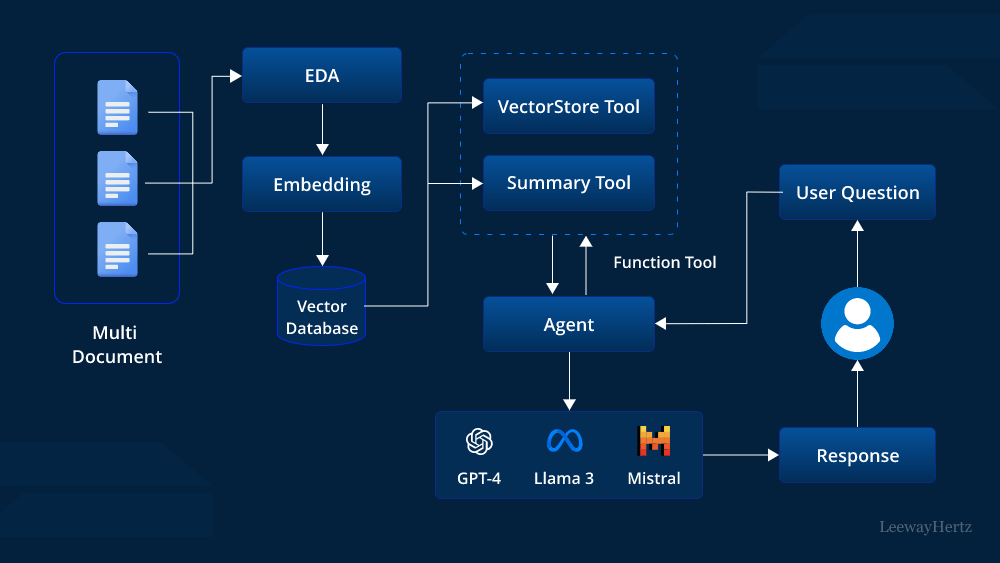
What is Agentic RAG?
Agentic RAG, or Retrieval-Augmented Generation, refers to a model that combines two major aspects of artificial intelligence: retrieval and generation. Traditionally, AI models either focus on generating responses from a fixed knowledge base or retrieving information from external sources. Agentic RAG takes it a step further by merging these two processes.
The model retrieves information from an external knowledge source and uses that data to generate more contextually accurate and relevant responses. This makes it highly effective for scenarios where information is constantly evolving or is too vast for a fixed dataset.
Agentic RAG provides the ability to augment AI’s knowledge dynamically, giving it a more comprehensive and real-time understanding of the context it is operating within.
How Agentic RAG Works
The core process of Agentic RAG involves two primary steps: retrieval and generation.
- Retrieval:
The first phase of Agentic RAG involves retrieving relevant information from an external knowledge source, such as a large database or the internet. Unlike static models that rely on a pre-trained dataset, Agentic RAG actively searches for the most relevant data based on the query it receives. - Generation:
After retrieving the relevant data, the model then generates a coherent and contextually appropriate response. The generation phase of Agentic RAG leverages deep learning techniques to combine the retrieved information with the model’s internal understanding, producing answers that are both accurate and insightful.
By combining these two phases, Agentic RAG can generate responses that are grounded in real-time data, making it a powerful tool in AI-driven information retrieval.
Benefits of Agentic RAG
Agentic RAG offers several advantages over traditional AI models, making it a valuable asset in the rapidly evolving landscape of AI technology.
1. Dynamic Knowledge Base
Unlike conventional AI models that rely on pre-trained data, Agentic RAG can dynamically retrieve information from external sources. This allows the model to access the latest information, which is particularly important in industries where data is continuously updated, such as healthcare, finance, or news reporting.
2. Improved Accuracy
Because Agentic RAG retrieves specific data to answer a query, it can generate responses that are more accurate and contextually relevant. Traditional models might provide generalized answers, but Agentic RAG focuses on finding the most precise and up-to-date information.
3. Reduced Memory Constraints
Conventional models often require large memory capacities to store extensive datasets. Agentic RAG, however, minimizes this need by retrieving data in real-time. This allows for the generation of answers without requiring the storage of an enormous amount of static data.
4. Enhanced Scalability
Agentic RAG is highly scalable, as it is not limited to a fixed knowledge base. It can grow with the expansion of external databases and information sources, making it highly adaptable for industries that deal with extensive and ever-expanding datasets.
Applications of Agentic RAG
The capabilities of Agentic RAG have broad applications across numerous industries. Here are a few examples where the model can be effectively employed.
1. Customer Support
Agentic RAG can be utilized in automated customer support systems to provide accurate and real-time answers to customer queries. Instead of relying on a pre-set list of FAQs, the model can retrieve relevant information from external sources, making it a valuable tool for addressing more complex and dynamic customer needs.
2. Healthcare
In the healthcare industry, where medical knowledge is rapidly expanding, Agentic RAG can assist professionals by retrieving the most current research findings, clinical guidelines, and treatment protocols. This can enhance decision-making and ensure that medical professionals have access to the latest information.
3. Educational Tools
Agentic RAG can improve educational platforms by generating accurate and up-to-date learning materials. As educational content evolves, the model can provide learners with fresh information, making it a valuable asset for teachers, students, and educational institutions.
4. Content Creation
In content creation, Agentic RAG can assist in generating well-informed articles, reports, and other materials by pulling from a wide array of information sources. This is particularly useful for industries like journalism, marketing, and research, where accuracy and relevance are critical.
5. Legal Sector
Legal professionals can benefit from Agentic RAG by retrieving the latest case laws, legal precedents, and regulatory updates. The model can generate detailed legal opinions or summaries based on up-to-date and specific information, saving time and increasing efficiency in legal research.
Challenges and Considerations
While Agentic RAG presents numerous advantages, there are also challenges associated with its implementation.
1. Quality of Retrieved Data
One of the primary challenges of Agentic RAG is ensuring the quality of the retrieved data. Since the model relies on external sources, it’s essential to ensure that the information is accurate, reliable, and relevant. This requires careful selection and monitoring of the data sources used.
2. Computational Complexity
Agentic RAG requires considerable computational resources, especially during the retrieval process. Integrating real-time retrieval with the generation process can be computationally intensive, which may limit its use in applications where speed is crucial.
3. Security Concerns
When retrieving data from external sources, there is always a risk of exposing sensitive information. It’s essential to implement robust security protocols to ensure that the information retrieved is safe and that the privacy of users is maintained.
Conclusion
Agentic RAG represents a significant advancement in the field of AI, combining the power of real-time data retrieval with the intelligence of deep learning models. By enabling more dynamic, accurate, and scalable information generation, Agentic RAG opens up new possibilities across various industries. Despite the challenges associated with its implementation, the potential of this technology is vast, and it is likely to play a key role in the future of AI-driven solutions. As data continues to grow exponentially, tools like Agentic RAG will become increasingly important in managing and utilizing this information effectively.
 Tech blog
Leave a comment