In recent years, artificial intelligence (AI) has emerged as a transformative force in various sectors, including business management. By integrating AI into business practices, organizations can streamline operations, enhance decision-making, and drive growth. This article explores the significant impact of AI in business management, its applications, benefits, and future prospects.
Understanding AI in Business Management
AI in business management refers to the use of artificial intelligence technologies to optimize and automate various aspects of organizational operations. This can include anything from data analysis and customer service to resource management and strategic planning. The application of AI helps businesses achieve greater efficiency and accuracy, making it a critical tool for modern management practices.
Applications of AI in Business Management
- Data Analysis and Insights One of the most valuable applications of AI in business management is its ability to process and analyze large volumes of data. AI-driven analytics tools can identify trends, forecast market conditions, and provide actionable insights. This allows businesses to make data-driven decisions, improving strategic planning and operational efficiency.
- Customer Relationship Management (CRM) AI has revolutionized customer relationship management by offering advanced tools for personalization and automation. AI-powered CRM systems can analyze customer interactions and preferences, enabling businesses to tailor their communications and offers. This leads to improved customer satisfaction and retention.
- Operational Efficiency AI enhances operational efficiency by automating routine tasks and optimizing workflows. For instance, AI can manage inventory, streamline supply chain operations, and handle administrative duties. This reduces human error and frees up valuable time for employees to focus on more strategic tasks.
- Predictive Analytics Predictive analytics is another area where AI in business management proves invaluable. By analyzing historical data, AI models can predict future trends and behaviors. This is particularly useful in forecasting sales, managing risks, and planning for future growth.
- Human Resources and Recruitment In human resources, AI can automate the recruitment process by screening resumes, scheduling interviews, and assessing candidates. AI tools can also enhance employee engagement by analyzing feedback and predicting potential issues. This leads to a more efficient and effective HR function.
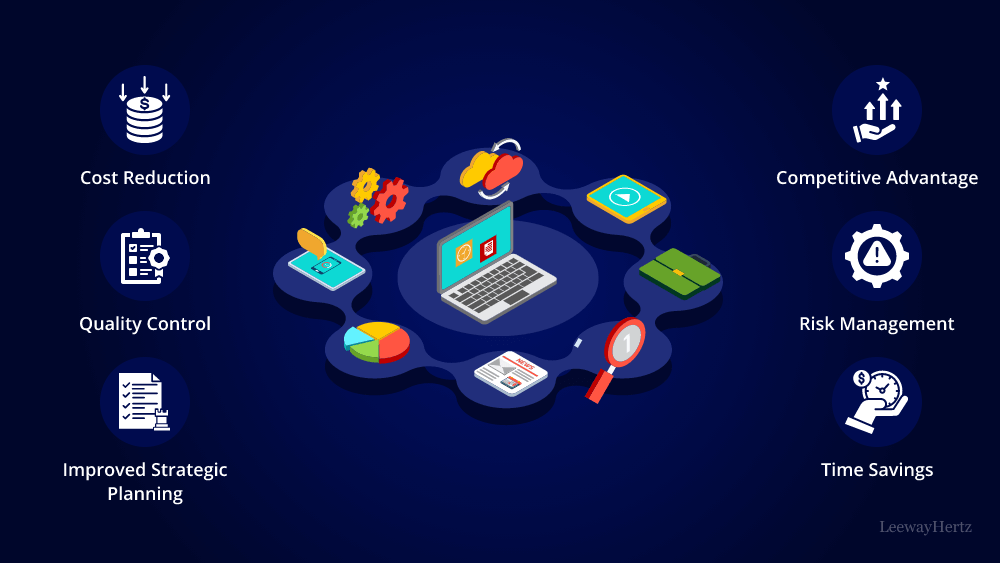
Benefits of AI in Business Management
- Increased Efficiency AI significantly increases efficiency by automating repetitive tasks and streamlining processes. This reduces operational costs and allows businesses to allocate resources more effectively.
- Enhanced Decision-Making With AI-driven insights, businesses can make more informed decisions based on data analysis rather than intuition alone. This leads to better strategic planning and more accurate forecasting.
- Improved Customer Experience AI enables businesses to provide a more personalized customer experience through targeted marketing and responsive customer service. This enhances customer satisfaction and loyalty.
- Cost Savings By automating processes and improving efficiency, AI can lead to substantial cost savings. Reduced labor costs and minimized errors contribute to a more cost-effective operation.
- Scalability AI solutions are highly scalable, allowing businesses to grow without being constrained by manual processes. This scalability supports expansion and adapts to increasing demands.
Challenges and Considerations
Despite its benefits, integrating AI into business management comes with challenges. One major concern is the cost of implementation, which can be significant for some organizations. Additionally, there may be resistance to change from employees who are accustomed to traditional methods. Businesses must also address data privacy and security issues associated with AI technologies.
Future Prospects of AI in Business Management
The future of AI in business management looks promising. As AI technology continues to advance, its applications will become even more sophisticated and widespread. Emerging trends such as AI-driven decision support systems and advanced automation will further enhance business management practices.
Furthermore, as AI becomes more accessible, small and medium-sized enterprises (SMEs) will increasingly benefit from its capabilities. The democratization of AI technology will enable more businesses to leverage its advantages, fostering innovation and competition in the marketplace.
Conclusion
AI in business management is reshaping the way organizations operate and make decisions. By leveraging AI technologies, businesses can enhance efficiency, improve customer experiences, and drive growth. While there are challenges to overcome, the benefits of AI are substantial and offer a competitive edge in today’s dynamic business environment. Embracing AI in business management is not just a trend but a strategic necessity for future success.
 Tech blog
Leave a comment