In the rapidly evolving field of artificial intelligence, generative AI has emerged as a powerful tool with applications ranging from creative content generation to data augmentation. This article will guide you through the essential steps on how to build a generative AI solution, ensuring that you understand both the technical and strategic aspects of the process.
Understanding Generative AI
Generative AI refers to a subset of artificial intelligence that focuses on creating new content or data that mimics existing patterns. This can include generating text, images, music, or even complex data structures. To successfully build a generative AI solution, you need to understand the fundamentals of generative models, such as Generative Adversarial Networks (GANs) and Variational Autoencoders (VAEs).
Defining the Problem and Objectives
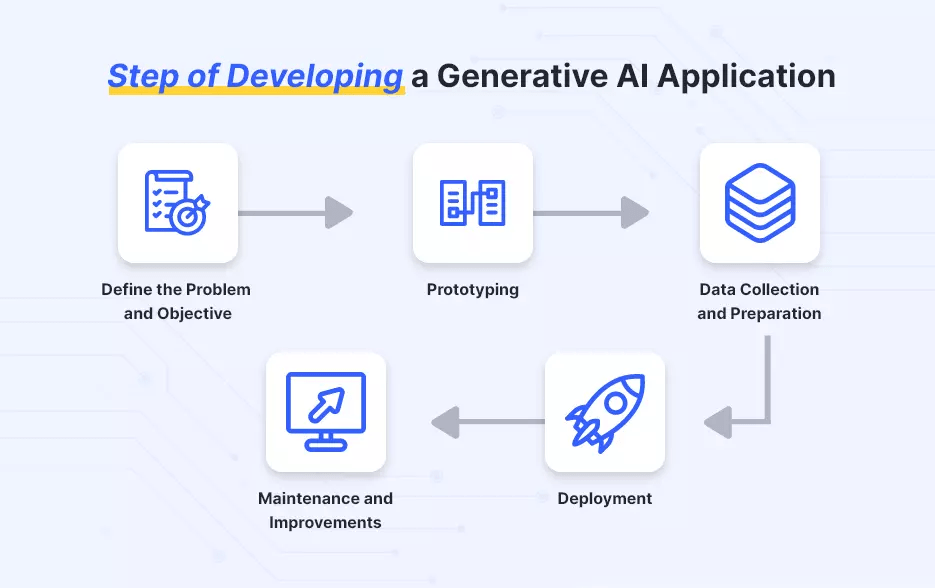
Before diving into the technical details, it’s crucial to clearly define the problem you aim to solve with your generative AI solution. Are you looking to generate realistic images, create engaging text content, or produce new music compositions? Establishing clear objectives will guide the design and implementation of your AI model.
Collecting and Preparing Data
The quality of your generative AI solution heavily depends on the data you use for training. Collect relevant datasets that align with your objectives. For instance, if you’re developing a text generation model, gather a large corpus of text data. Data preparation involves cleaning, preprocessing, and organizing the data to ensure it’s suitable for training your AI model.
Choosing the Right Model
Selecting the appropriate generative model is a critical step in how to build a generative AI solution. Here are a few popular options:
- Generative Adversarial Networks (GANs): GANs consist of two networks—a generator and a discriminator—that work against each other to improve the quality of the generated output.
- Variational Autoencoders (VAEs): VAEs are designed to learn efficient representations of the input data and generate new data samples from these learned representations.
- Transformers: For text-based generative tasks, transformer models like GPT (Generative Pre-trained Transformer) can be highly effective.
Evaluate the strengths and weaknesses of each model type in the context of your objectives to make an informed decision.
Training the Model
Training a generative AI model involves feeding it the prepared data and optimizing its parameters to improve performance. This step requires significant computational resources and time. During training, you’ll adjust hyperparameters, monitor performance metrics, and iteratively refine the model to enhance its ability to generate high-quality outputs.
Evaluating and Fine-Tuning
Once the model is trained, it’s essential to evaluate its performance. Use various metrics and evaluation techniques to assess how well the model meets your objectives. For example, if you’re generating text, you might evaluate the coherence and relevance of the output. Fine-tuning involves making adjustments based on evaluation results to further improve the model’s performance.
Implementing and Deploying
After fine-tuning your model, the next step is to implement it in a practical application. This involves integrating the model into a user interface or system where it can be used by end-users. Consider scalability and performance when deploying your generative AI solution to ensure it can handle real-world demands effectively.
Monitoring and Maintenance
Building a generative AI solution doesn’t end with deployment. Continuous monitoring is necessary to ensure the model performs as expected and adapts to any changes in data or user needs. Regular maintenance, including updating the model and addressing any issues, will help keep your AI solution effective and relevant.
Addressing Ethical Considerations
Generative AI raises several ethical considerations, including issues related to data privacy, bias, and the potential misuse of generated content. It’s important to address these concerns proactively by implementing safeguards and guidelines to ensure that your generative AI solution is used responsibly.
Conclusion
Building a generative AI solution involves a combination of technical expertise, strategic planning, and ongoing maintenance. By following the steps outlined above—understanding generative AI, defining objectives, collecting and preparing data, choosing the right model, training, evaluating, implementing, and addressing ethical considerations—you can create a robust generative AI solution that meets your needs and contributes to the advancement of AI technology.
 Tech blog
Leave a comment