Generative AI has rapidly transformed various industries by creating content, generating insights, and enhancing user experiences. To comprehend how this technology works, it’s essential to understand the Generative AI tech stack, which includes frameworks, infrastructure, models, and applications. This article delves into each component, providing a clear and straightforward overview.
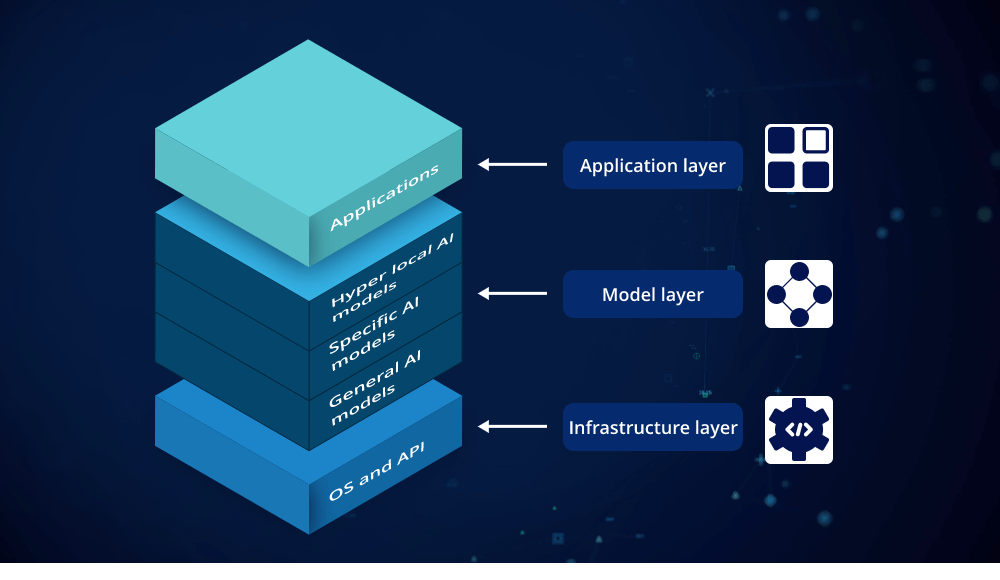
1. Generative AI Frameworks
Generative AI frameworks are the building blocks that enable developers to create and train models. These frameworks provide the tools and libraries necessary for designing and implementing machine learning algorithms.
Popular Generative AI Frameworks
- TensorFlow: Developed by Google, TensorFlow is a widely-used open-source framework that supports a range of machine learning and deep learning tasks. Its flexibility and extensive community support make it a popular choice for developing generative models.
- PyTorch: Maintained by Facebook’s AI Research lab, PyTorch is known for its dynamic computation graph and ease of use. It has gained popularity for research and production in generative AI, particularly due to its user-friendly interface and strong community backing.
- Hugging Face Transformers: This library provides pre-trained models and tools for natural language processing tasks. Its ease of integration with other frameworks and its extensive collection of pre-trained models make it a key player in the generative AI space.
2. Generative AI Infrastructure
The infrastructure for Generative AI refers to the hardware and software environments that support the development, training, and deployment of generative models. Proper infrastructure is crucial for handling the computational demands of AI tasks.
Key Components of Generative AI Infrastructure
- Compute Power: Generative AI models often require substantial computational resources. GPUs (Graphics Processing Units) and TPUs (Tensor Processing Units) are commonly used to accelerate model training and inference due to their parallel processing capabilities.
- Storage: Large datasets are essential for training generative models. High-capacity storage solutions, including cloud-based storage, are used to manage and access these datasets efficiently.
- Cloud Platforms: Platforms such as AWS, Google Cloud, and Microsoft Azure provide scalable infrastructure for developing and deploying generative AI models. They offer tools and services that simplify the process of managing computational resources and storing data.
3. Generative AI Models
Generative AI models are designed to create new content or data that mimics existing patterns. These models are at the heart of Generative AI technology and come in various types, each suited to different tasks.
Types of Generative AI Models
- Generative Adversarial Networks (GANs): GANs consist of two neural networks—one generating data and the other evaluating it. The generator creates new data, while the discriminator assesses its quality. Through this adversarial process, GANs can produce high-quality images, audio, and text.
- Variational Autoencoders (VAEs): VAEs are used to generate data by learning a probabilistic distribution of the input data. They are particularly effective in creating variations of existing data, making them useful for applications such as image denoising and anomaly detection.
- Transformers: Originally designed for natural language processing, transformers have shown remarkable versatility. They can generate coherent text, translate languages, and even produce creative writing. Models like GPT (Generative Pre-trained Transformer) are prominent examples of transformer-based generative models.
4. Generative AI Applications
Generative AI applications span various domains, demonstrating the versatility and impact of this technology. Here are some notable applications:
Content Creation
Generative AI is revolutionizing content creation by automating the generation of text, images, and videos. Tools powered by generative models can create articles, design graphics, and even compose music, significantly speeding up creative processes.
Healthcare
In healthcare, generative AI models are used to generate synthetic medical data, which helps in training diagnostic algorithms without compromising patient privacy. Additionally, they assist in drug discovery by predicting molecular structures and potential interactions.
Entertainment
The entertainment industry benefits from generative AI through content generation and personalized experiences. AI-driven tools can create realistic visual effects, generate new music tracks, and even create virtual characters for video games.
Finance
In the financial sector, generative AI models assist in predicting market trends and generating financial reports. They analyze historical data to forecast future performance and create simulated scenarios for risk assessment.
Conclusion
The Generative AI tech stack is a multifaceted ecosystem comprising frameworks, infrastructure, models, and applications. Understanding each component is crucial for leveraging the full potential of generative AI technology. As this field continues to evolve, staying informed about the latest developments in frameworks, infrastructure, and models will be essential for harnessing the power of Generative AI in various applications. Whether you are a developer, researcher, or industry professional, grasping the nuances of the Generative AI tech stack will help you navigate and utilize this transformative technology effectively.
 Tech blog
Leave a comment