Introduction: The Growing Role of AI Agents in Research
Artificial Intelligence (AI) agents are becoming increasingly prevalent in research, revolutionizing how scientific discoveries are made and accelerating advancements across various fields. AI agents in research are sophisticated software programs designed to perform tasks that traditionally required human intelligence. These tasks include analyzing data, generating hypotheses, and even conducting experiments. As AI technology continues to evolve, its integration into research processes offers unprecedented opportunities for innovation and efficiency.
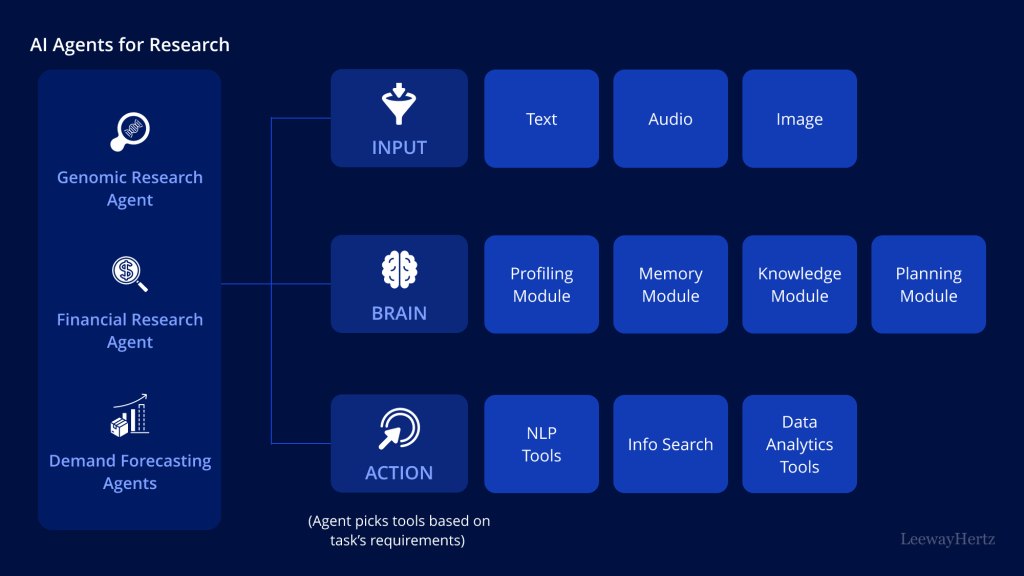
Understanding AI Agents in Research
AI agents in research are designed to simulate human cognitive functions, such as learning, problem-solving, and decision-making. These agents use algorithms and computational models to process vast amounts of data quickly and accurately. By leveraging machine learning techniques, AI agents can identify patterns and correlations that may be invisible to human researchers.
The ability of AI agents to handle large datasets is particularly valuable in fields such as genomics, epidemiology, and environmental science. For instance, AI agents can analyze genetic information to predict disease susceptibility or assess environmental changes to forecast the impact of climate change. This capability allows researchers to make more informed decisions and develop targeted interventions.
Enhancing Research Efficiency with AI Agents
One of the primary benefits of AI agents in research is their ability to streamline and accelerate research processes. Traditional research methods often involve manual data collection and analysis, which can be time-consuming and prone to human error. AI agents can automate these tasks, freeing researchers to focus on higher-level thinking and creative problem-solving.
For example, in drug discovery, AI agents can analyze chemical compounds and predict their effectiveness in treating specific diseases. This process, known as computational drug screening, significantly reduces the time and cost associated with developing new medications. AI agents can also help researchers design more efficient experiments by suggesting optimal conditions and parameters based on previous findings.
AI Agents in Research: Driving Innovation
AI agents are not only improving the efficiency of research but also driving innovation by enabling new approaches to scientific inquiry. Machine learning algorithms used by AI agents can uncover novel insights and generate hypotheses that may not be immediately apparent through traditional methods. This ability to identify unexpected correlations and trends opens up new avenues for exploration and discovery.
In the field of materials science, for instance, AI agents can predict the properties of new materials before they are synthesized in the lab. This predictive capability allows researchers to explore a broader range of material combinations and accelerate the development of advanced materials for various applications, from electronics to renewable energy.
Challenges and Considerations
While the benefits of AI agents in research are substantial, there are also challenges and considerations that researchers must address. One major concern is the quality and reliability of the data used to train AI agents. If the data is biased or incomplete, the AI agents may produce misleading results, potentially impacting the validity of research findings.
Additionally, the use of AI agents in research raises ethical and privacy concerns, particularly when handling sensitive data. Researchers must ensure that AI agents are used responsibly and that data privacy is maintained throughout the research process.
The Future of AI Agents in Research
Looking ahead, the role of AI agents in research is expected to grow even more prominent. Advances in AI technology will continue to enhance the capabilities of these agents, enabling them to tackle increasingly complex problems and provide deeper insights. As AI agents become more sophisticated, they will likely play a crucial role in addressing some of the most pressing challenges facing humanity, such as climate change, disease prevention, and sustainable development.
Researchers and policymakers will need to work together to address the challenges associated with AI agents in research and ensure that these technologies are used ethically and effectively. By harnessing the power of AI agents, the research community can unlock new possibilities and drive progress in a wide range of scientific disciplines.
Conclusion: Embracing the Potential of AI Agents in Research
AI agents in research are transforming the landscape of scientific inquiry by enhancing efficiency, driving innovation, and uncovering new insights. As these technologies continue to advance, they hold the potential to revolutionize how research is conducted and pave the way for groundbreaking discoveries. By embracing the potential of AI agents and addressing the associated challenges, researchers can harness their capabilities to push the boundaries of knowledge and contribute to a brighter future.
In summary, AI agents in research represent a powerful tool that is reshaping the way scientists approach their work. Their ability to analyze large datasets, automate tasks, and generate new hypotheses makes them invaluable assets in the quest for scientific advancement. As we continue to explore the possibilities offered by AI agents, the future of research looks increasingly promising and exciting.
 Tech blog
Leave a comment