Introduction
In today’s data-driven world, businesses and organizations are inundated with vast amounts of data. Analyzing this data effectively is crucial for making informed decisions and gaining competitive advantages. Traditional data analysis methods, while still valuable, often struggle to keep pace with the increasing volume, variety, and velocity of data. This is where AI agents for data analysis come into play, offering a powerful solution to streamline the process, enhance accuracy, and provide deeper insights.
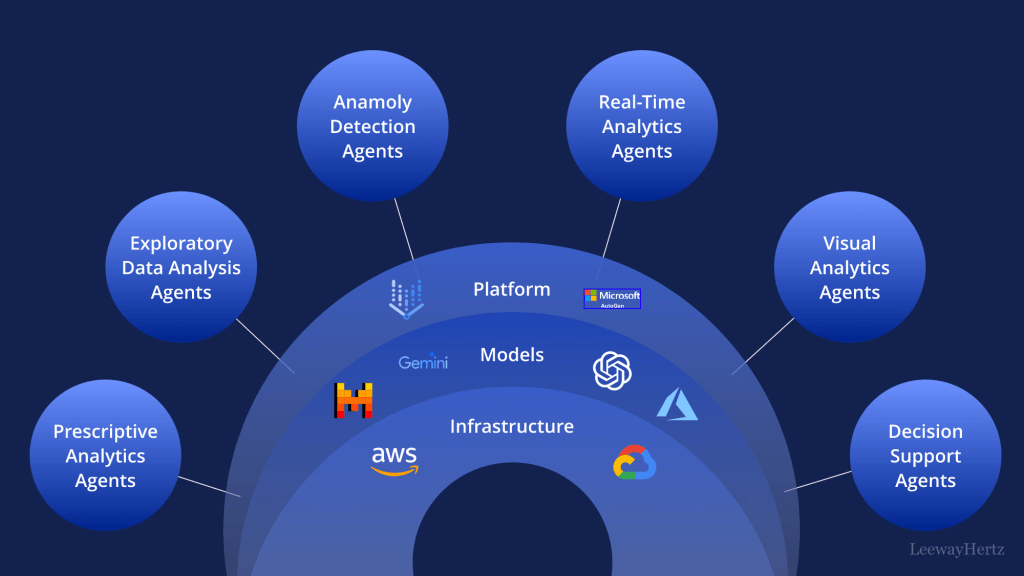
What Are AI Agents for Data Analysis?
AI agents for data analysis are specialized software programs that use artificial intelligence techniques, such as machine learning, natural language processing, and advanced algorithms, to analyze data. These agents are designed to automate data analysis tasks, identify patterns, make predictions, and generate actionable insights. Unlike traditional data analysis methods, AI agents can handle large datasets, adapt to new data inputs, and continuously learn from their interactions with data, making them highly efficient and accurate.
How AI Agents for Data Analysis Work
AI agents for data analysis operate by processing raw data through a series of steps that include data collection, cleaning, processing, and interpretation. Here’s a simplified overview of how these agents work:
- Data Collection: AI agents collect data from various sources, such as databases, sensors, social media, and other digital platforms. They can handle structured data, like spreadsheets, and unstructured data, like text and images.
- Data Cleaning: Once the data is collected, AI agents clean and preprocess it by removing duplicates, correcting errors, and transforming it into a suitable format for analysis. This step is crucial to ensure the accuracy and reliability of the results.
- Data Analysis: The core function of AI agents for data analysis is to examine the data using advanced algorithms. These agents can perform descriptive, predictive, and prescriptive analysis, depending on the specific needs of the user. For instance, they can identify trends, forecast future outcomes, or suggest optimal actions based on the analyzed data.
- Insight Generation: After analyzing the data, AI agents present their findings in a user-friendly format, such as dashboards, reports, or visualizations. These insights can help organizations make data-driven decisions quickly and confidently.
Benefits of Using AI Agents for Data Analysis
The adoption of AI agents for data analysis offers numerous benefits that can significantly enhance the efficiency and effectiveness of data-driven decision-making processes:
1. Increased Efficiency and Speed
AI agents for data analysis can process large volumes of data much faster than traditional methods, reducing the time required to generate insights. This speed allows organizations to respond quickly to market changes, customer needs, or operational challenges.
2. Improved Accuracy
By automating data analysis, AI agents minimize human errors and biases that can affect the quality of the results. They use sophisticated algorithms to ensure that the analysis is accurate, consistent, and reliable.
3. Scalability
AI agents for data analysis can easily scale to handle growing amounts of data, making them ideal for businesses of all sizes. Whether dealing with a small dataset or a massive data lake, these agents can adapt and maintain their performance.
4. Cost Savings
Automating data analysis with AI agents can reduce the need for extensive manual labor, lowering operational costs. Additionally, the ability to quickly generate insights can lead to more informed decisions, potentially saving money by avoiding costly mistakes.
5. Enhanced Decision-Making
AI agents provide decision-makers with precise and actionable insights, enabling them to make better decisions based on data rather than intuition or guesswork. This data-driven approach can lead to improved outcomes across various business functions, from marketing and sales to supply chain management and customer service.
Applications of AI Agents for Data Analysis
AI agents for data analysis are versatile tools that can be applied across a wide range of industries and use cases. Some of the most common applications include:
1. Marketing and Customer Insights
AI agents can analyze customer data to identify buying patterns, preferences, and trends. This information can help businesses tailor their marketing strategies, improve customer engagement, and boost sales.
2. Financial Analysis and Risk Management
In finance, AI agents can assess financial data to identify risks, predict market trends, and optimize investment strategies. They can also detect fraudulent activities by analyzing transaction patterns and anomalies.
3. Healthcare and Diagnostics
AI agents for data analysis are increasingly used in healthcare to analyze patient data, support diagnostics, and recommend personalized treatment plans. They can also track the spread of diseases and predict healthcare trends.
4. Supply Chain Optimization
AI agents help businesses optimize their supply chains by analyzing data related to inventory levels, demand forecasts, and supplier performance. This can lead to improved efficiency, reduced costs, and better customer satisfaction.
Challenges and Future of AI Agents for Data Analysis
While AI agents for data analysis offer significant advantages, there are challenges to consider, such as data privacy concerns, the need for high-quality data, and the complexity of implementing AI solutions. However, as technology continues to evolve, these challenges are likely to diminish, paving the way for even more advanced and accessible AI agents.
Conclusion
AI agents for data analysis are revolutionizing the way organizations handle and interpret data. By automating and enhancing the data analysis process, these agents empower businesses to make faster, more accurate, and data-driven decisions. As AI technology advances, the role of AI agents in data analysis will only grow, making them an indispensable tool in the modern data landscape.
 Tech blog
Leave a comment