Multi-agent systems (MAS) are a rapidly growing area in artificial intelligence and computer science. They involve multiple interacting agents that can cooperate or compete to achieve specific goals. These systems are versatile and can be applied in various domains, offering unique advantages in solving complex problems. This article explores the types of multi-agent systems, how they work, their applications, and their benefits.
Types of Multi-Agent Systems
Multi-agent systems can be categorized based on the nature of the agents and their interactions. Here are the primary types:
- Cooperative Multi-Agent Systems: In these systems, agents work together to achieve a common goal. They share information and resources, making collective decisions to optimize the overall outcome. Cooperative systems are often used in tasks requiring teamwork, such as collaborative robotics and distributed problem-solving.
- Competitive Multi-Agent Systems: Unlike cooperative systems, competitive MAS involve agents with opposing goals. These systems are common in environments like auctions, market simulations, and gaming, where agents must strategize to outmaneuver their competitors.
- Mixed Multi-Agent Systems: These systems combine elements of both cooperation and competition. Agents may collaborate on certain tasks while competing in others. Mixed MAS are prevalent in complex environments where agents need to balance collaboration and competition to achieve their objectives, such as in multi-player online games and autonomous vehicle coordination.
- Hierarchical Multi-Agent Systems: In hierarchical MAS, agents are organized in a structured hierarchy, with higher-level agents overseeing and directing lower-level agents. This type is beneficial in large-scale systems where a clear chain of command and coordination is required, such as in organizational management and large-scale manufacturing processes.
How Multi-Agent Systems Work
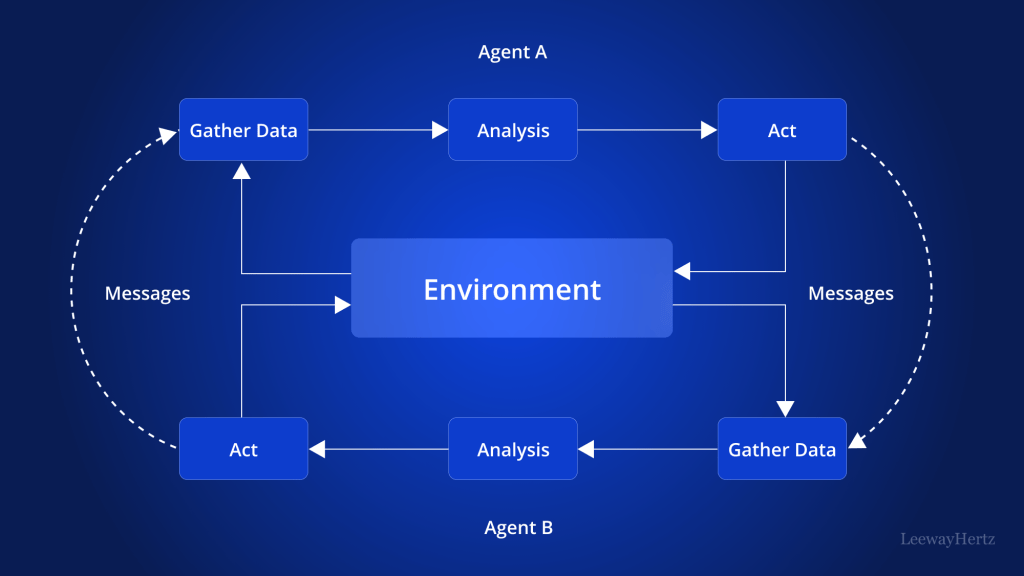
Multi-agent systems operate based on the principles of interaction and coordination among agents. Here’s a simplified explanation of their working mechanism:
- Agent Definition: Each agent in a MAS is an autonomous entity with its own set of rules and behaviors. Agents can be physical robots, software programs, or even human operators. They possess capabilities to perceive their environment, make decisions, and act upon those decisions.
- Communication: Agents in a MAS communicate with each other to share information, negotiate, and coordinate their actions. This communication can be direct (e.g., messages) or indirect (e.g., shared environment or artifacts).
- Coordination: To achieve their goals, agents need to coordinate their activities. Coordination mechanisms can be centralized (managed by a single agent) or decentralized (managed by multiple agents through negotiation and consensus).
- Learning and Adaptation: Many MAS incorporate learning algorithms that allow agents to adapt their behavior based on experiences and changing conditions. This adaptability is crucial for dealing with dynamic environments and improving system performance over time.
Applications of Multi-Agent Systems
Multi-agent systems are used in a wide range of applications, demonstrating their versatility and effectiveness. Some notable examples include:
- Traffic Management: In intelligent transportation systems, MAS are used to control and manage traffic flow. Agents can optimize traffic signals, manage congestion, and improve overall road safety by coordinating with each other and responding to real-time conditions.
- Robotics: In robotics, MAS enable teams of robots to work together on tasks such as search and rescue missions, warehouse management, and exploration. Collaborative robots can perform complex operations that would be difficult for a single robot to accomplish alone.
- Market Simulation: MAS are employed in economic and financial markets to simulate trading environments, analyze market dynamics, and predict trends. Agents representing buyers and sellers interact to model market behaviors and optimize trading strategies.
- Healthcare: In healthcare, MAS can assist in patient management, resource allocation, and treatment planning. Agents can coordinate medical resources, manage patient information, and support decision-making processes in hospitals and clinics.
- Smart Homes: MAS are used in smart home systems to manage and control various devices such as lights, thermostats, and security systems. Agents can communicate and coordinate to enhance convenience, energy efficiency, and security in residential environments.
Benefits of Multi-Agent Systems
The adoption of multi-agent systems offers several significant benefits:
- Scalability: MAS can efficiently handle large-scale problems by distributing tasks among multiple agents. This scalability is essential for managing complex systems and dynamic environments.
- Flexibility: Multi-agent systems are highly adaptable to changes. Agents can modify their behavior based on new information, making MAS suitable for environments that are subject to frequent changes or uncertainties.
- Robustness: The decentralized nature of MAS enhances system robustness. If one agent fails or behaves unexpectedly, other agents can continue to operate and maintain the system’s overall functionality.
- Improved Performance: By leveraging collaboration and coordination, MAS can achieve better performance and efficiency compared to single-agent systems. Agents can share tasks, optimize resource usage, and enhance overall system effectiveness.
- Enhanced Problem-Solving: MAS can tackle complex problems that are beyond the capabilities of individual agents. Through cooperation and negotiation, agents can solve intricate tasks that require diverse skills and perspectives.
In summary, multi-agent systems represent a powerful approach to solving complex problems through the interaction of multiple autonomous agents. With various types, effective working mechanisms, diverse applications, and numerous benefits, MAS continue to play a crucial role in advancing technology and improving various domains. As research and development in this field progress, the potential for MAS to address even more sophisticated challenges will likely expand.
 Tech blog
Leave a comment