Introduction
Generative AI in healthcare represents a groundbreaking shift in the way medical professionals approach diagnosis, treatment, and patient care. This innovative technology leverages advanced algorithms and machine learning to create new solutions and insights, fundamentally transforming the healthcare landscape. In this article, we will explore the various applications of generative AI in healthcare, its benefits, challenges, and the future it promises for the medical field.
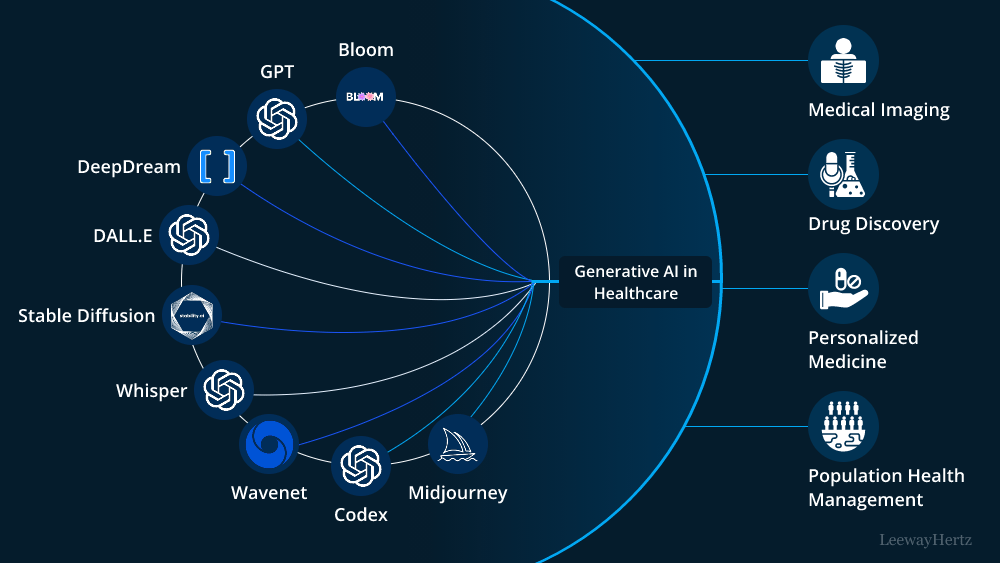
What is Generative AI in Healthcare?
Generative AI in healthcare refers to the use of artificial intelligence systems that can generate new data, solutions, or insights by learning from existing medical information. Unlike traditional AI, which primarily analyzes and interprets data, generative AI creates novel content or models based on learned patterns. This can include everything from generating synthetic medical data to developing new treatment protocols.
Applications of Generative AI in Healthcare
- Drug Discovery and Development One of the most exciting applications of generative AI in healthcare is in the realm of drug discovery. Traditional methods of drug development are time-consuming and costly. Generative AI can accelerate this process by predicting how different compounds might interact with biological targets, thus identifying potential new drugs more efficiently. By analyzing vast datasets of chemical compounds and biological information, generative AI helps researchers design molecules with specific properties, potentially leading to faster and more cost-effective drug development.
- Personalized Medicine Generative AI in healthcare is also revolutionizing personalized medicine. By analyzing patient data, including genetic information, generative AI models can identify patterns that might be missed by human analysts. This enables the creation of tailored treatment plans based on an individual’s unique genetic makeup, lifestyle, and medical history. Personalized medicine promises to improve treatment efficacy and minimize adverse effects, ultimately enhancing patient outcomes.
- Medical Imaging and Diagnostics Generative AI in healthcare is transforming medical imaging and diagnostics by improving the accuracy and efficiency of image analysis. AI algorithms can generate synthetic medical images to augment training datasets, enhancing the ability of diagnostic tools to identify abnormalities. Additionally, generative AI can assist in the creation of high-resolution images from lower-quality scans, providing clearer insights for radiologists and enabling earlier and more accurate diagnoses.
- Clinical Decision Support Clinical decision support systems powered by generative AI can assist healthcare providers in making informed decisions. By analyzing patient data and generating predictive models, these systems can suggest possible diagnoses, treatment options, and potential outcomes. This helps clinicians make data-driven decisions, reducing the likelihood of human error and improving overall patient care.
Benefits of Generative AI in Healthcare
- Increased Efficiency Generative AI in healthcare streamlines various processes, from drug discovery to patient diagnostics. By automating repetitive tasks and analyzing large volumes of data quickly, generative AI enables healthcare professionals to focus on more complex and critical aspects of patient care.
- Enhanced Accuracy The precision of generative AI models leads to more accurate diagnoses and treatment plans. By identifying subtle patterns and correlations in data, these AI systems can provide insights that might be overlooked by human practitioners, leading to more effective and personalized healthcare.
- Cost Savings Generative AI in healthcare can significantly reduce costs associated with drug development, medical imaging, and other areas. By speeding up processes and improving accuracy, these AI systems minimize the need for costly trials and reworks, ultimately leading to savings for both healthcare providers and patients.
- Improved Patient Outcomes The application of generative AI in healthcare contributes to better patient outcomes by facilitating early diagnosis, personalized treatment plans, and more efficient care. This holistic approach ensures that patients receive the most effective and timely interventions, enhancing their overall health and well-being.
Challenges and Considerations
- Data Privacy and Security The use of generative AI in healthcare raises concerns about data privacy and security. Ensuring that patient data is protected from unauthorized access and breaches is critical. Healthcare providers must implement robust security measures and adhere to regulations to safeguard sensitive information.
- Ethical and Bias Issues Generative AI models are only as good as the data they are trained on. If the training data contains biases, these biases can be reflected in the AI’s outputs. It is essential to address these ethical considerations and ensure that generative AI systems are developed and used in a way that promotes fairness and equity in healthcare.
- Integration into Existing Systems Integrating generative AI into existing healthcare systems can be challenging. Healthcare providers need to ensure that AI tools are compatible with current technologies and workflows. Training staff to effectively use these new systems is also crucial for successful implementation.
The Future of Generative AI in Healthcare
The future of generative AI in healthcare holds immense promise. As technology continues to advance, we can expect even more innovative applications that enhance patient care and streamline medical processes. Ongoing research and development will likely lead to new breakthroughs, making generative AI an integral part of modern healthcare.
Conclusion
Generative AI in healthcare is poised to revolutionize the industry by offering new solutions and insights that improve patient care, streamline processes, and reduce costs. As we continue to explore and develop this technology, it is crucial to address the associated challenges and ensure that generative AI is used ethically and effectively. With its transformative potential, generative AI is set to play a pivotal role in the future of healthcare.
 Tech blog
Leave a comment