AI-based recommendation systems have become an integral part of the digital landscape, enhancing user experiences across various platforms. These systems leverage artificial intelligence (AI) to suggest products, services, or content based on users’ preferences and behavior. This article explores the different types of AI-based recommendation systems, their use cases, and the development and implementation processes that make them effective.
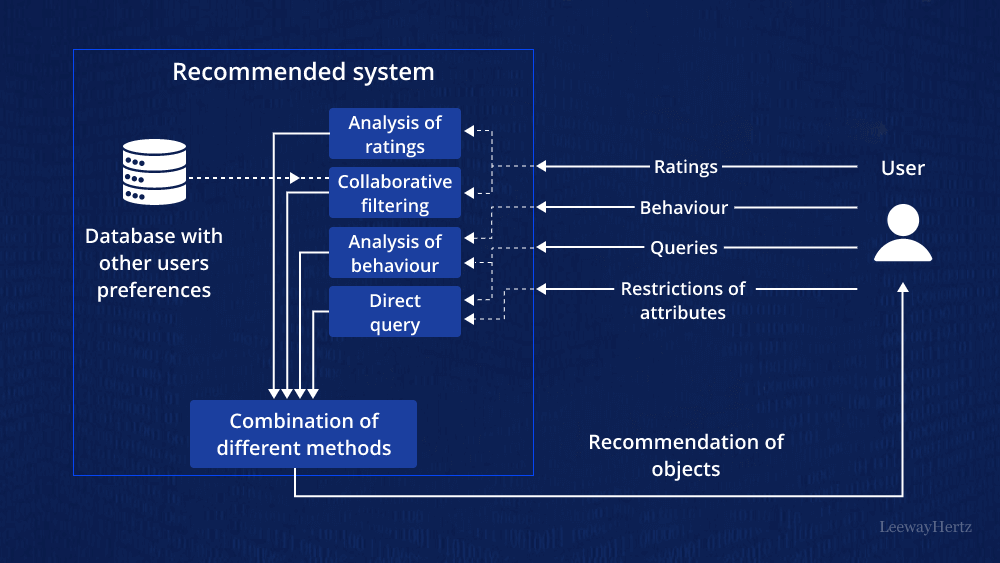
Types of AI-Based Recommendation Systems
AI-based recommendation systems come in several types, each tailored to different needs and use cases. The primary types include:
1. Collaborative Filtering
Collaborative filtering is one of the most widely used methods in AI-based recommendation systems. It relies on user interactions and preferences to recommend items. There are two main types of collaborative filtering:
- User-Based Collaborative Filtering: This approach finds users with similar preferences and recommends items based on what other similar users have liked.
- Item-Based Collaborative Filtering: This method recommends items similar to those a user has liked or interacted with previously.
2. Content-Based Filtering
Content-based filtering focuses on the characteristics of items and users. It recommends items that are similar to ones the user has shown interest in, based on attributes like genre, keywords, or features. This method is particularly useful for personalizing recommendations in contexts where user preferences are well-defined and stable.
3. Hybrid Recommendation Systems
Hybrid recommendation systems combine collaborative and content-based filtering to leverage the strengths of both methods. By integrating multiple techniques, these systems can provide more accurate and diverse recommendations. For instance, Netflix uses a hybrid approach to suggest movies and shows, blending user behavior data with content attributes.
4. Knowledge-Based Systems
Knowledge-based recommendation systems use domain knowledge and rules to make suggestions. They are particularly effective in scenarios where user preferences are specific or the items have a high level of complexity. For example, a recommendation system for choosing a financial investment would use detailed knowledge about financial products and user goals.
Use Cases of AI-Based Recommendation Systems
AI-based recommendation systems are utilized across various industries to enhance user engagement and drive business success. Some notable use cases include:
1. E-Commerce
In e-commerce, AI-based recommendation systems suggest products based on users’ browsing history, purchase behavior, and preferences. Amazon, for instance, uses these systems to recommend products like “Customers who bought this also bought,” which helps increase cross-selling and upselling opportunities.
2. Streaming Services
Streaming platforms like Netflix and Spotify utilize recommendation systems to suggest movies, TV shows, or music based on users’ past interactions. These recommendations help users discover new content and keep them engaged with the platform.
3. Social Media
Social media platforms like Facebook and Instagram use AI-based recommendation systems to curate content feeds. By analyzing user interactions, these systems suggest posts, groups, or friends that align with users’ interests and behavior.
4. Online Advertising
AI-based recommendation systems play a crucial role in online advertising by targeting ads to users based on their browsing history and preferences. This targeted approach increases the relevance of ads and improves conversion rates.
Development of AI-Based Recommendation Systems
Developing an effective AI-based recommendation system involves several steps:
1. Data Collection
The first step is to gather data on user behavior, preferences, and interactions. This data can come from various sources, including user profiles, clickstreams, purchase histories, and feedback.
2. Data Processing
Once collected, the data needs to be processed and cleaned. This involves handling missing values, removing duplicates, and transforming data into a format suitable for analysis.
3. Model Selection
Choosing the right model is crucial for an AI-based recommendation system. Depending on the type of system, developers may use algorithms such as matrix factorization, nearest neighbor methods, or deep learning techniques.
4. Training and Evaluation
The chosen model must be trained on the data to learn patterns and relationships. After training, the model is evaluated using metrics such as precision, recall, and F1 score to ensure its effectiveness.
5. Deployment and Monitoring
Once the model is trained and evaluated, it is deployed in a production environment. Continuous monitoring is essential to track the system’s performance and make necessary adjustments based on user feedback and evolving trends.
Implementation of AI-Based Recommendation Systems
Implementing an AI-based recommendation system requires careful planning and execution. Key considerations include:
1. Integration with Existing Systems
The recommendation system should seamlessly integrate with existing platforms, such as e-commerce sites or streaming services. This integration ensures that recommendations are delivered in real-time and are relevant to users’ current context.
2. Scalability
As user data grows, the recommendation system should be scalable to handle increased data volume and complexity. Cloud-based solutions and distributed computing can help manage scalability challenges.
3. Privacy and Security
User privacy and data security are critical in AI-based recommendation systems. Implementing robust security measures and complying with data protection regulations, such as GDPR, are essential to safeguard user information.
4. Continuous Improvement
AI-based recommendation systems should be continuously improved based on user feedback and performance metrics. Regular updates and model retraining help maintain the accuracy and relevance of recommendations.
Conclusion
AI-based recommendation systems are powerful tools that enhance user experiences by providing personalized suggestions. By understanding the different types of recommendation systems, their use cases, and the development and implementation processes, businesses can leverage AI to drive engagement and achieve better outcomes. Whether in e-commerce, streaming services, social media, or online advertising, these systems play a crucial role in shaping how users interact with digital content and services.
 Tech blog
Leave a comment