Introduction to Generative AI in Enterprises
Generative AI has rapidly evolved from a niche technology into a cornerstone of modern enterprise solutions. With its ability to create new content, generate insights, and automate complex tasks, it has become a game-changer in AI application development services. This article delves into how generative AI architecture is transforming enterprises, enhancing their capabilities, and streamlining their operations.
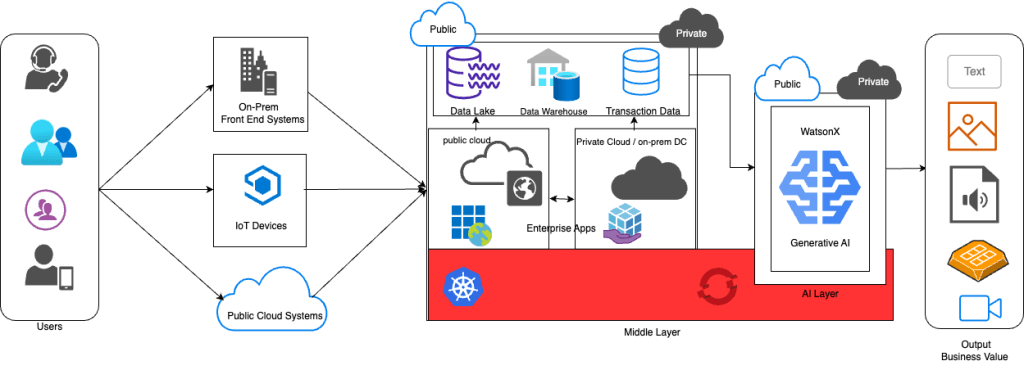
Understanding Generative AI Architecture
Generative AI architecture refers to the underlying framework and models that enable AI systems to generate new, valuable outputs. Unlike traditional AI, which focuses on recognizing patterns and making predictions based on existing data, generative AI creates new data or content. This is achieved through sophisticated algorithms and neural networks, such as Generative Adversarial Networks (GANs) and Variational Autoencoders (VAEs). These models are designed to learn from existing data and generate outputs that are indistinguishable from real-world data.
Key Components of Generative AI Architecture
- Data Input and Preprocessing: For generative AI to produce high-quality outputs, it requires large volumes of well-prepared data. This data is preprocessed to ensure it is clean, structured, and relevant to the desired output. In the context of AI application development services, data preprocessing involves tasks such as data normalization, augmentation, and feature extraction.
- Generative Models: At the core of generative AI architecture are the generative models. GANs, for example, consist of two neural networks—the generator and the discriminator. The generator creates new data samples, while the discriminator evaluates their authenticity. VAEs, on the other hand, learn to encode data into a latent space and then decode it back into new samples. These models enable enterprises to create diverse and high-quality outputs.
- Training and Optimization: Training generative models involves adjusting their parameters to improve performance. This process is resource-intensive and requires substantial computational power. Optimization techniques, such as stochastic gradient descent and regularization, are used to enhance the efficiency and accuracy of these models.
- Deployment and Integration: Once trained, generative models are deployed into production environments. This involves integrating them with existing systems and workflows. For enterprises, this means incorporating generative AI into their software solutions, data pipelines, and business processes.
Benefits of Generative AI for Enterprises
- Enhanced Creativity and Innovation: Generative AI enables enterprises to push the boundaries of creativity. For instance, in marketing and advertising, AI-generated content can be used to create compelling visuals, copy, and campaigns that resonate with target audiences.
- Improved Personalization: By analyzing customer data, generative AI can create highly personalized experiences. This is particularly valuable in e-commerce, where AI can generate product recommendations, personalized offers, and tailored content to enhance customer engagement and satisfaction.
- Cost and Time Efficiency: Automating content creation and data generation reduces the need for manual intervention, saving time and resources. Enterprises can streamline their operations by leveraging generative AI to handle repetitive tasks and generate new content quickly.
- Advanced Data Analysis: Generative AI can uncover insights from complex datasets that might be missed through traditional analysis methods. This enables enterprises to make data-driven decisions and gain a competitive edge.
Applications of Generative AI in Enterprise Solutions
- Product Development: Generative AI can assist in designing new products by generating prototypes and simulations. This accelerates the product development cycle and reduces costs associated with physical prototyping.
- Customer Service: AI-powered chatbots and virtual assistants can handle customer queries, provide support, and generate responses that are contextually relevant and engaging. This improves customer service efficiency and satisfaction.
- Content Creation: Enterprises can use generative AI to produce a wide range of content, from articles and reports to marketing materials and social media posts. This not only speeds up content creation but also ensures consistency and quality.
- Financial Forecasting: Generative AI can model complex financial scenarios and generate forecasts based on historical data. This helps enterprises in strategic planning and risk management.
Challenges and Considerations
While generative AI offers numerous benefits, enterprises must also be mindful of certain challenges:
- Data Privacy and Security: Handling sensitive data requires stringent security measures to protect against breaches and unauthorized access.
- Ethical Concerns: The ability of generative AI to create realistic but fake content raises ethical issues. Enterprises must navigate these concerns and ensure that their use of AI aligns with ethical standards.
- Model Bias: Generative models can inadvertently learn and perpetuate biases present in the training data. It is crucial for enterprises to address and mitigate these biases to ensure fair and equitable outcomes.
Conclusion
Generative AI architecture is revolutionizing AI application development services and transforming how enterprises operate. By understanding its components and benefits, enterprises can leverage generative AI to enhance creativity, improve efficiency, and drive innovation. As the technology continues to advance, it is essential for businesses to stay informed and address potential challenges to fully harness the power of generative AI.
 Tech blog
Leave a comment