Introduction
Diffusion models are powerful tools in artificial intelligence, renowned for their ability to generate high-quality images and data. In the realm of AI application development services, mastering diffusion model training can significantly enhance the capabilities and outputs of your projects. This article provides a straightforward, step-by-step guide on how to train a diffusion model effectively, ensuring clarity and ease of understanding.
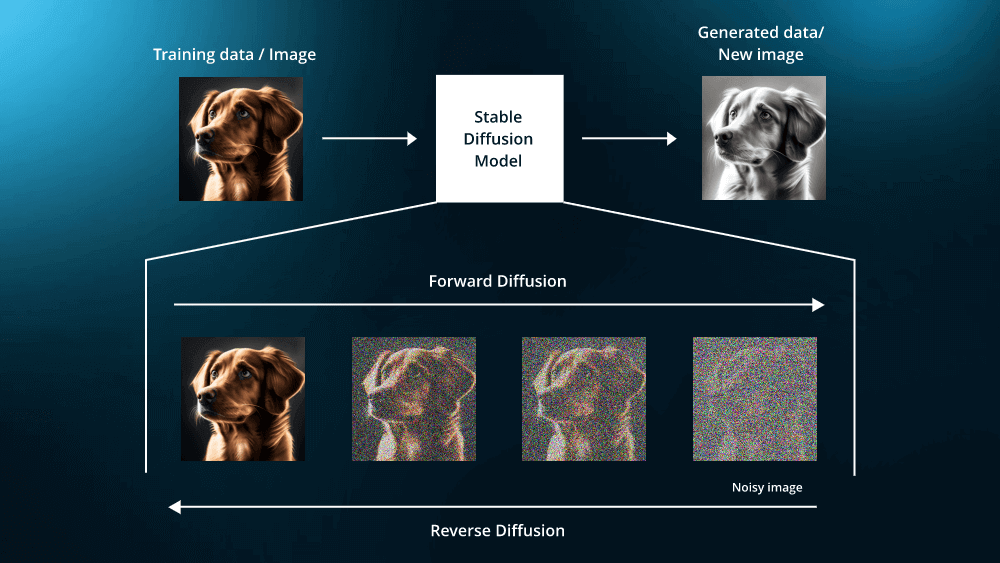
1. Understanding Diffusion Models
Diffusion models are a class of generative models that work by simulating a diffusion process. They start with random noise and iteratively refine this noise to generate coherent and high-quality data. Unlike traditional methods that use a fixed noise distribution, diffusion models use a stochastic process to model data distributions. In AI application development services, these models are particularly useful for tasks involving image generation, data augmentation, and more.
2. Preparing Your Dataset
Before diving into training, it’s essential to prepare your dataset. The quality and relevance of the dataset directly impact the performance of your diffusion model. Here’s how to prepare:
- Collect Data: Gather a diverse and high-quality dataset that aligns with your application’s goals. For example, if you’re developing an AI application for medical imaging, ensure your dataset consists of varied and high-resolution medical images.
- Preprocess Data: Clean and preprocess the data to ensure it is in a format suitable for training. This may involve resizing images, normalizing data, and splitting the dataset into training, validation, and test sets.
3. Choosing the Right Framework
Selecting an appropriate machine learning framework is crucial for efficient training. Popular frameworks such as TensorFlow and PyTorch offer extensive support for diffusion models and are commonly used in AI application development services. Choose a framework based on your team’s expertise and the specific requirements of your project.
4. Configuring the Diffusion Model
Configuring your diffusion model involves setting various hyperparameters and architectural choices. Key parameters include:
- Noise Schedule: Determines how noise is added to the data throughout the diffusion process.
- Model Architecture: Choose an architecture that suits your data and application. Common architectures for diffusion models include U-Net and Transformer-based models.
- Training Parameters: Set learning rates, batch sizes, and optimization algorithms to fine-tune the model’s performance.
5. Training the Model
With your dataset and configuration ready, you can begin training the diffusion model. Here’s a simplified overview of the training process:
- Initialize the Model: Start by initializing your diffusion model with the chosen architecture and parameters.
- Feed Data: Input your preprocessed data into the model. The diffusion process will gradually transform random noise into structured data through iterative refinement.
- Monitor Progress: Continuously monitor the training process using metrics such as loss and accuracy. Make adjustments to the hyperparameters if necessary to improve performance.
- Validation and Testing: Regularly validate the model using a separate validation set to ensure it generalizes well to unseen data. Once training is complete, evaluate the model’s performance on the test set to assess its effectiveness.
6. Fine-Tuning and Optimization
After the initial training, fine-tuning is essential to enhance the model’s performance. This involves:
- Adjusting Hyperparameters: Experiment with different learning rates, batch sizes, and other parameters to optimize performance.
- Regularization Techniques: Apply regularization methods to prevent overfitting and improve the model’s ability to generalize.
- Data Augmentation: Incorporate data augmentation techniques to increase the diversity of your training data and enhance model robustness.
7. Deploying the Trained Model
Once you’ve trained and fine-tuned your diffusion model, the next step is deployment. In AI application development services, deployment involves integrating the trained model into your application’s workflow. This may include:
- Model Integration: Embed the model into your application or service infrastructure.
- Performance Monitoring: Continuously monitor the model’s performance in a real-world setting and make adjustments as needed.
- User Feedback: Collect feedback from end-users to identify areas for improvement and ensure the model meets user needs effectively.
8. Continuous Improvement
Training a diffusion model is not a one-time task but an ongoing process. Regularly update the model with new data and retrain it to keep it relevant and effective. Leverage advancements in AI research to incorporate new techniques and improvements into your diffusion model training process.
Conclusion
Training a diffusion model is a multifaceted process that requires careful preparation, configuration, and ongoing optimization. By following these steps, you can effectively harness the power of diffusion models for your AI application development services. Whether you’re generating images, enhancing data, or creating innovative applications, mastering diffusion model training will enhance your capabilities and drive success in your AI projects.
 Tech blog
Leave a comment