Artificial Intelligence (AI) is rapidly transforming numerous industries, and private equity & principal investment are no exception. The integration of AI in private equity & principal investment is revolutionizing how firms operate, invest, and generate returns. This article explores the profound impact of AI on these sectors, focusing on its applications, benefits, and future prospects.
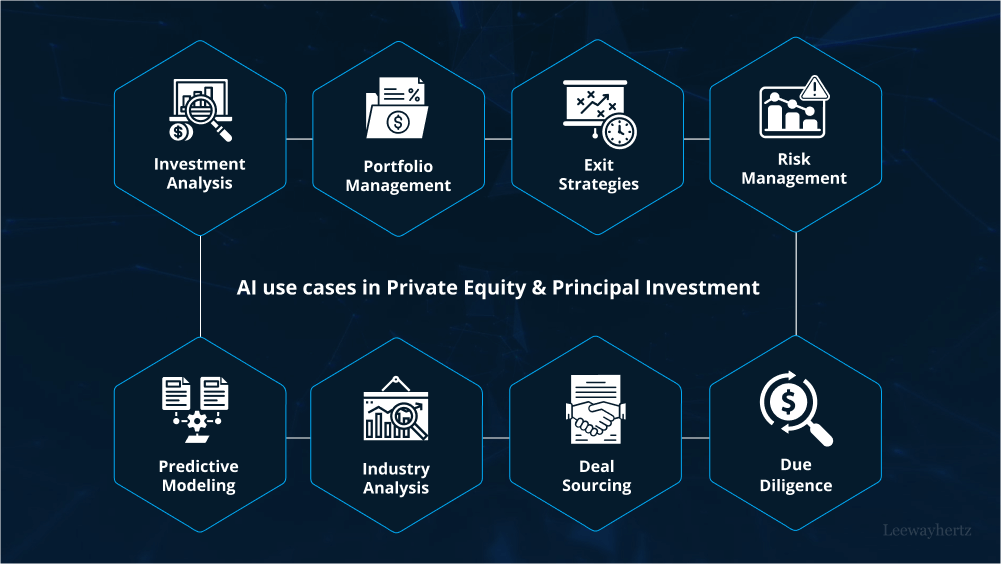
The Advent of AI in Private Equity & Principal Investment
Private equity & principal investment traditionally rely on extensive data analysis, market research, and decision-making processes. With the advent of AI, these tasks are becoming more streamlined and efficient. AI systems can analyze vast amounts of data at unprecedented speeds, providing insights that were previously unattainable.
Enhancing Due Diligence
One of the most significant benefits of AI in private equity & principal investment is enhancing due diligence processes. Due diligence involves a thorough investigation of potential investment opportunities, requiring meticulous analysis of financial statements, market conditions, and operational metrics. AI-powered tools can automate these processes, quickly identifying potential risks and opportunities.
AI algorithms can sift through financial documents, news articles, and social media posts to provide a comprehensive view of a company’s performance and reputation. This not only saves time but also ensures more accurate and informed investment decisions.
Predictive Analytics for Better Investment Decisions
Predictive analytics is another critical application of AI in private equity & principal investment. By leveraging historical data and machine learning models, AI can predict future market trends and investment outcomes. This helps firms make proactive decisions, optimize their investment strategies, and mitigate risks.
For instance, AI can identify patterns and correlations in data that human analysts might overlook. It can forecast market movements, predict the success of new products, and even anticipate economic downturns. This predictive capability is invaluable for private equity firms seeking to maximize returns and stay ahead of the competition.
Portfolio Management and Optimization
Effective portfolio management is crucial for the success of private equity & principal investment firms. AI technologies are enhancing this aspect by providing real-time insights and optimization strategies. AI-driven portfolio management tools can monitor and analyze the performance of investments continuously, offering recommendations for rebalancing and asset allocation.
Moreover, AI can assess the impact of various market scenarios on a portfolio, enabling firms to adjust their strategies accordingly. This dynamic and data-driven approach to portfolio management enhances overall performance and reduces the likelihood of losses.
Automating Routine Tasks
AI in private equity & principal investment is also helping automate routine tasks, freeing up valuable time for investment professionals. Tasks such as data entry, report generation, and compliance checks can be efficiently handled by AI-powered systems. This allows professionals to focus on higher-value activities, such as strategic planning and relationship building.
For example, natural language processing (NLP) technologies can automate the extraction of relevant information from legal documents, contracts, and financial reports. This not only speeds up the process but also reduces the risk of human error.
Enhancing Customer Relations and Personalization
AI is also transforming customer relations and personalization in private equity & principal investment. AI-driven customer relationship management (CRM) systems can analyze client data to provide personalized recommendations and services. This enhances client satisfaction and fosters long-term relationships.
By understanding clients’ preferences, risk tolerance, and investment goals, AI can tailor investment strategies to meet individual needs. This level of personalization is crucial for attracting and retaining clients in a competitive market.
Ethical and Regulatory Considerations
While the benefits of AI in private equity & principal investment are substantial, it is essential to consider ethical and regulatory aspects. The use of AI raises questions about data privacy, transparency, and accountability. Firms must ensure that their AI systems comply with relevant regulations and ethical standards.
Transparency in AI decision-making processes is vital to maintain trust with clients and stakeholders. Firms should implement robust governance frameworks to oversee the deployment and use of AI technologies, ensuring they align with ethical principles and regulatory requirements.
Future Prospects of AI in Private Equity & Principal Investment
The future of AI in private equity & principal investment looks promising. As AI technologies continue to evolve, their applications in these sectors will expand. We can expect more sophisticated predictive models, enhanced automation capabilities, and greater integration of AI with other emerging technologies such as blockchain and the Internet of Things (IoT).
The ongoing development of AI will further streamline operations, improve decision-making, and enhance the overall efficiency of private equity & principal investment firms. Embracing AI will be crucial for firms seeking to stay competitive and capitalize on new opportunities in a rapidly changing financial landscape.
Conclusion
AI in private equity & principal investment is a game-changer, offering numerous benefits from enhanced due diligence and predictive analytics to automated tasks and personalized customer relations. While there are challenges to address, the potential for AI to revolutionize these sectors is immense. By leveraging AI, private equity & principal investment firms can optimize their operations, make better-informed decisions, and achieve superior returns.
 Tech blog
Leave a comment