Introduction
In the rapidly evolving world of technology, generative AI is revolutionizing various industries by creating new content and solving complex problems. If you’re wondering how to build a generative AI solution, you’ve come to the right place. This guide will walk you through the essential steps and considerations for developing a robust generative AI system. From understanding the basics to implementing and optimizing your model, we’ll cover everything you need to know to get started.
Understanding Generative AI
Before diving into how to build a generative AI solution, it’s crucial to understand what generative AI is. Generative AI refers to a type of artificial intelligence that can generate new data, content, or solutions based on the patterns it has learned from existing data. Unlike discriminative models that classify or predict, generative models create new examples, such as text, images, or even music.
Step 1: Define Your Objectives
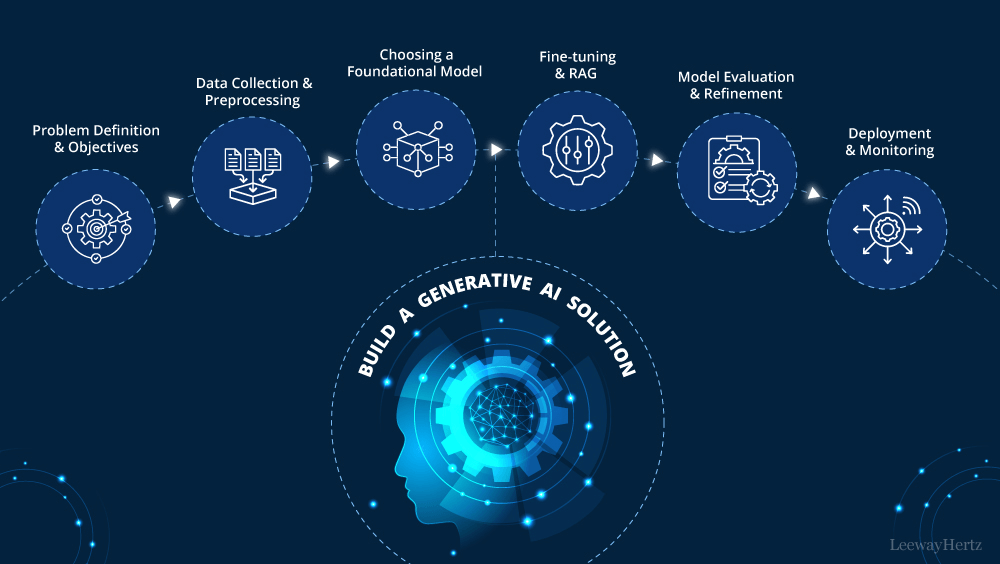
The first step in how to build a generative AI solution is defining what you want to achieve. Are you interested in generating text, images, audio, or something else? Clearly outline the problem you want to solve and set specific goals. For instance, if you’re developing a content generation tool, your objective might be to create high-quality, relevant text based on user input.
Step 2: Collect and Prepare Data
Data is the foundation of any generative AI solution. Gather a large and diverse dataset that aligns with your objectives. For text generation, you might collect articles, books, or web content. For image generation, you would need a substantial collection of images relevant to your domain.
Once you have your data, preprocess it to ensure it’s clean and suitable for training. This includes removing irrelevant information, normalizing data, and splitting it into training and validation sets. Data quality and relevance are critical for the success of your generative AI model.
Step 3: Choose the Right Model
Selecting the right model is crucial when learning how to build a generative AI solution. Several models are available, each suited for different types of generative tasks. Some popular models include:
- Generative Adversarial Networks (GANs): These consist of a generator and a discriminator that compete with each other, making them ideal for image generation.
- Variational Autoencoders (VAEs): VAEs are used for generating new data points that resemble the training data, often used in image and text generation.
- Transformers: Especially effective for natural language processing tasks, transformers can generate coherent and contextually relevant text.
Choose the model that best fits your objectives and data type. For example, if you’re focusing on text generation, transformer-based models like GPT (Generative Pre-trained Transformer) may be suitable.
Step 4: Train Your Model
Training is a pivotal step in how to build a generative AI solution. Feed your preprocessed data into the chosen model and adjust the parameters to improve performance. Training involves optimizing the model’s weights using techniques like gradient descent.
Monitor the training process closely to ensure your model learns effectively. You may need to fine-tune hyperparameters such as learning rate, batch size, and epochs to achieve the best results. Utilize validation data to evaluate the model’s performance and avoid overfitting.
Step 5: Evaluate and Optimize
Once your model is trained, it’s time to evaluate its performance. Assess the quality and relevance of the generated content against your objectives. For text, check for coherence, grammatical accuracy, and relevance to the prompt. For images, evaluate the visual fidelity and diversity.
Based on the evaluation, you may need to optimize your model. This can involve tweaking hyperparameters, adding more data, or experimenting with different architectures. Continuous improvement is key to achieving high-quality generative outputs.
Step 6: Deploy Your Solution
With your generative AI model trained and optimized, it’s time to deploy it. Choose a deployment platform that aligns with your needs, whether it’s a cloud service, on-premises server, or integrated within an application. Ensure that your deployment environment can handle the computational requirements of your model.
Integrate your model with the user interface or application where it will be used. Provide clear instructions and options for users to interact with the generative AI solution effectively.
Step 7: Monitor and Maintain
Building a generative AI solution doesn’t end with deployment. Continuous monitoring and maintenance are essential to ensure optimal performance. Collect user feedback to identify areas for improvement and update your model as needed.
Regularly check for model drift or degradation, where the performance may decline over time due to changing data patterns. Retrain or fine-tune your model periodically to keep it relevant and effective.
Conclusion
Learning how to build a generative AI solution involves several critical steps, from defining your objectives to deploying and maintaining your model. By understanding the basics, preparing your data, choosing the right model, and continuously optimizing, you can create a powerful generative AI system that meets your needs.
Generative AI holds immense potential across various fields, and with the right approach, you can harness its capabilities to innovate and solve complex problems. Follow this guide, and you’ll be well on your way to developing a successful generative AI solution.
 Tech blog
Leave a comment