In today’s fast-paced and highly competitive business landscape, effective inventory management is crucial for maintaining a healthy supply chain, minimizing costs, and ensuring customer satisfaction. The advent of Artificial Intelligence (AI) has brought about a transformative change in this domain. AI in inventory management is not just a technological advancement but a strategic necessity that offers businesses a competitive edge through enhanced accuracy, efficiency, and responsiveness.
The Role of AI in Inventory Management
AI in inventory management leverages machine learning algorithms, predictive analytics, and data processing capabilities to streamline and optimize the entire inventory process. This includes demand forecasting, stock replenishment, order fulfillment, and warehouse management. By integrating AI, businesses can shift from reactive to proactive inventory management, anticipating needs and mitigating risks before they impact the supply chain.
Demand Forecasting
One of the most significant applications of AI in inventory management is demand forecasting. Traditional methods rely on historical sales data and basic statistical models, which often fail to account for complex market dynamics and external factors. AI algorithms, on the other hand, can analyze vast amounts of data from multiple sources, including social media trends, economic indicators, and weather forecasts, to predict demand with remarkable accuracy. This allows businesses to adjust their inventory levels in real-time, reducing the risk of overstocking or stockouts.
Stock Replenishment
AI-driven systems can automate the stock replenishment process by continuously monitoring inventory levels and triggering orders when stock falls below predefined thresholds. Machine learning models can learn from past sales patterns and supplier performance to optimize reorder points and quantities, ensuring that inventory is available just in time. This not only improves cash flow but also reduces storage costs and minimizes waste.
Order Fulfillment and Optimization
AI in inventory management enhances order fulfillment by optimizing picking routes, managing order priorities, and predicting potential delays. Advanced AI algorithms can analyze order data to determine the most efficient way to process and ship orders, balancing speed, cost, and customer preferences. This leads to faster delivery times, reduced shipping costs, and higher customer satisfaction.
Warehouse Management
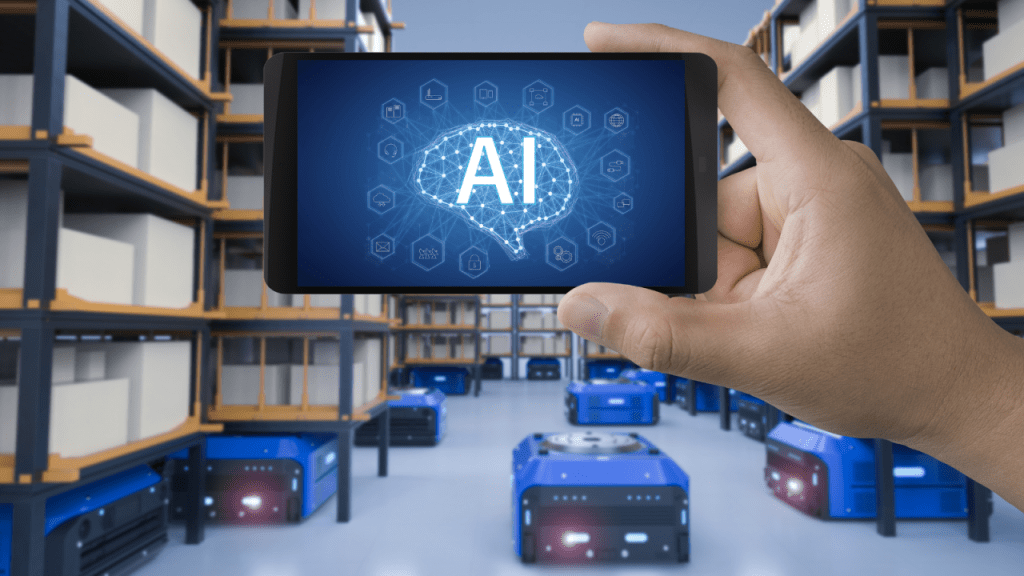
AI technologies, such as computer vision and robotics, are revolutionizing warehouse management. Automated guided vehicles (AGVs) and robotic picking systems can navigate warehouse floors with precision, reducing human error and increasing throughput. AI-powered warehouse management systems (WMS) can dynamically allocate storage locations based on real-time data, ensuring optimal space utilization and easy access to high-demand items.
Benefits of AI in Inventory Management
The integration of AI in inventory management offers numerous benefits that extend across the entire supply chain. These advantages include:
Enhanced Accuracy and Efficiency
AI algorithms can process and analyze data much faster and more accurately than human counterparts. This leads to improved accuracy in demand forecasting, stock replenishment, and order fulfillment, reducing errors and enhancing overall efficiency.
Cost Reduction
By optimizing inventory levels and automating routine tasks, AI helps businesses reduce carrying costs, labor expenses, and waste. Improved demand forecasting and efficient stock replenishment minimize the need for excess inventory, freeing up capital for other investments.
Increased Agility and Responsiveness
AI enables businesses to respond quickly to market changes, supply chain disruptions, and customer demands. Real-time data analysis and predictive insights allow for agile decision-making, ensuring that the supply chain remains resilient and adaptive.
Better Customer Satisfaction
With AI-enhanced order fulfillment and inventory management, businesses can ensure that products are available when and where customers need them. Faster delivery times, accurate order processing, and reduced stockouts contribute to a better customer experience and increased loyalty.
Strategic Decision-Making
AI provides valuable insights into inventory performance, supplier reliability, and market trends. These insights enable businesses to make informed strategic decisions, such as diversifying suppliers, optimizing product assortments, and identifying new market opportunities.
Challenges and Considerations
While the benefits of AI in inventory management are substantial, there are also challenges and considerations to keep in mind. Implementing AI requires significant investment in technology and infrastructure, as well as a cultural shift towards data-driven decision-making. Businesses must ensure that their data is accurate, comprehensive, and up-to-date to maximize the effectiveness of AI algorithms. Additionally, there is a need for skilled personnel who can manage and maintain AI systems, interpret the results, and translate insights into actionable strategies.
Data Privacy and Security
With the increasing reliance on AI and data analytics, concerns about data privacy and security are paramount. Businesses must implement robust data protection measures and comply with regulations such as GDPR to safeguard sensitive information and maintain customer trust.
Integration with Existing Systems
Integrating AI solutions with existing inventory management systems can be complex and time-consuming. Businesses need to ensure that new AI tools are compatible with their current infrastructure and processes, requiring careful planning and collaboration between IT and operations teams.
Continuous Improvement
AI models require continuous monitoring and updating to remain effective. Market conditions, consumer behavior, and supply chain dynamics are constantly evolving, and AI systems must adapt to these changes. Regularly retraining models and refining algorithms is essential to maintain their accuracy and relevance.
The Future of AI in Inventory Management
The future of AI in inventory management looks promising, with advancements in technology poised to bring even greater efficiencies and capabilities. The integration of AI with the Internet of Things (IoT) will enable real-time tracking and monitoring of inventory across the supply chain. Blockchain technology can enhance transparency and security, ensuring that data is accurate and tamper-proof.
Furthermore, the development of more sophisticated AI models, such as deep learning and reinforcement learning, will allow for even more precise demand forecasting and inventory optimization. As AI continues to evolve, businesses that embrace these innovations will be better positioned to navigate the complexities of the global supply chain and maintain a competitive edge.
Conclusion
AI in inventory management is revolutionizing the way businesses manage their supply chains. From demand forecasting and stock replenishment to order fulfillment and warehouse management, AI offers a range of solutions that enhance accuracy, efficiency, and responsiveness. While there are challenges to implementation, the benefits of AI far outweigh the obstacles. As technology continues to advance, the role of AI in inventory management will only grow, offering businesses new opportunities to optimize their operations and achieve sustainable growth.
 Tech blog
Leave a comment